
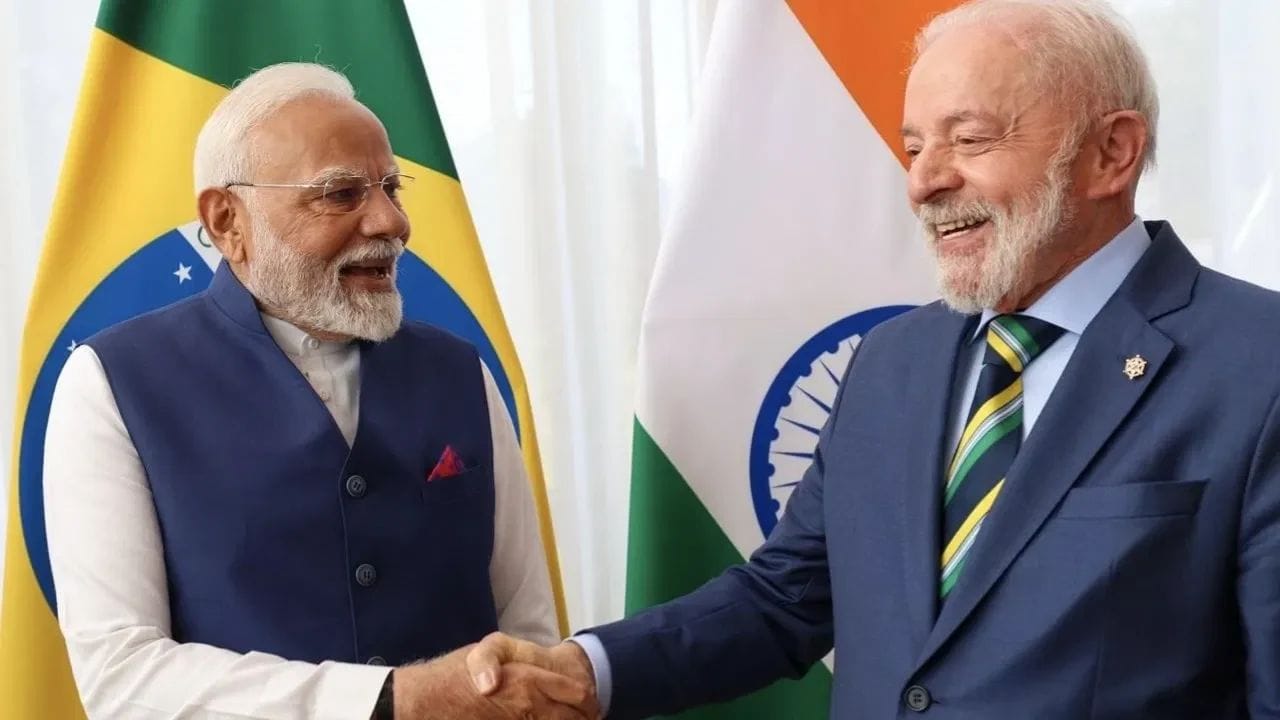
Prime Minister Narendra Modi congratulated Brazil’s newly re-elected President Luiz Inacio Lula da Silva, marking renewed focus on the bilateral ties between the two nations. Initially limited to trade, India-Brazil relations have evolved into an extensive economic and diplomatic partnership, aimed at providing a strong voice for developing economies on the global stage. Modi referred to Lula as his “dear friend” on social media and expressed eagerness to deepen this strategic partnership.
India and Brazil collaborate closely on important international issues like United Nations reform, climate change, and counterterrorism. Lula’s earlier presidential terms from 2003 to 2010 saw significant progress in strengthening ties, which have further expanded since his return to office in 2023. Both countries aim to amplify the influence of emerging economies within international institutions and negotiations.
Growing Trade Relations
The economic relationship between India and Brazil has grown substantially since Lula’s initial presidency. According to India’s Foreign Ministry, bilateral trade reached $15.21 billion in 2025, up over 25% from $12.2 billion in 2024. In the first half of 2026 alone, total trade hit $8.77 billion, a nearly 37% increase compared to the same period last year.
In 2025, India exported goods worth $8.35 billion to Brazil, including petroleum products, chemicals, pharmaceuticals, and engineering items. Imports from Brazil totaled $6.85 billion, featuring crude oil, soybean oil, raw sugar, cotton, and iron ore. During his visit to India in 2026, Lula set an ambitious target to raise bilateral trade to $30 billion, far exceeding the previously set $20 billion goal for 2030.
Lula described India as the “democratic brother” of the Global South during his address at the India-Brazil Economic Forum in New Delhi. He emphasized that their relationship is built on equality and mutual respect, distinguishing it from negotiations with wealthy nations. He noted that India is not a colonizer, highlighting the unique nature of their partnership.
Strategic Partnership and Diplomatic Ties
The foundation for today’s strong relations was laid during Lula’s first two terms. His 2004 visit to India as the Republic Day chief guest elevated ties to new heights. In 2006, during then Prime Minister Manmohan Singh’s visit to Brazil, the relationship was formally upgraded to a strategic partnership level. Both countries agreed to deepen cooperation in trade, technology, energy security, and international security.
Lula recalled how his earlier visits to India influenced Brazil’s economic policies, especially regarding foreign currency reserves. Noticing India’s approximately $100 billion foreign reserves in the mid-2000s, he realized the importance of maintaining ample reserves. Subsequently, Brazil increased its reserves to about $360 billion, strengthening its economic stability and position in international finance.
India and Brazil have united to create forums such as the IBSA Dialogue Forum with South Africa, launched in 2003. This platform promotes collaboration on agriculture, energy, health, education, science, and technology. Their collective efforts have also extended to groups like BRIC, aiming to ensure developing countries have a louder voice in global affairs.
Lula’s return is expected to inject fresh momentum into India-Brazil collaboration within BRICS and support reforms in global institutions like the UN Security Council. Both nations advocate for stronger roles of developing economies in international decision-making. Lula also suggested that bilateral trade payments could move beyond the U.S. dollar to local currencies like the Indian rupee and Brazilian real, though challenges remain. This shift could reduce dependency on the dollar and strengthen financial ties between the two economies.