

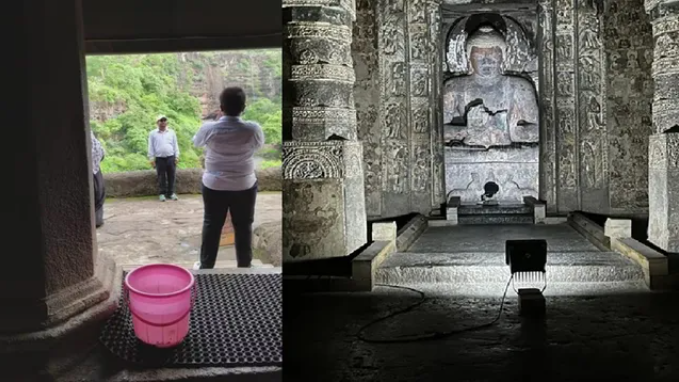
Chhatrapati Sambhajinagar, Maharashtra: A video showing buckets placed beneath dripping water inside the world-famous Ajanta Caves in Maharashtra has raised concerns over water leakage at the UNESCO World Heritage Site.
The video, which surfaced on social media, reportedly showed water dripping from sections of the cave ceiling during heavy rainfall. However, the Archaeological Survey of India (ASI) has clarified that there is no threat to the ancient sculptures inside the caves.
According to ASI officials, the buckets were placed as a precautionary measure to collect dripping rainwater and prevent it from accumulating on the floor, which could create a slipping hazard for visitors.
Water Seepage During Heavy Rainfall
ASI Deputy Superintendent Dr Shilpa Jamgade explained that the Ajanta Caves were carved directly into natural rock. During periods of intense rainfall, water can enter through natural openings, cracks and pores in the rock and eventually reach certain sections of the cave interiors.
Officials said such seepage during heavy rainfall does not necessarily indicate structural damage or damage to the ancient artwork.
The water is collected using buckets to keep visitor pathways dry and reduce the risk of accidents.
ASI Maintains Drainage System
The ASI has drainage arrangements above the cave complex to manage rainwater and minimise the possibility of water entering vulnerable sections of the caves.
Officials said these drainage systems are periodically cleaned and maintained so that rainwater can be diverted effectively, particularly during the monsoon season.
Regular monitoring becomes especially important during periods of intense rainfall because the Ajanta Caves are part of a natural rock formation rather than a conventional enclosed building.
Ancient Paintings and Sculptures Remain Protected
The Ajanta Caves are among India’s most important ancient heritage sites and are renowned for their Buddhist paintings, sculptures and rock-cut architecture.
The caves contain artwork depicting episodes associated with the life and teachings of the Buddha as well as stories from the Jataka tradition. Their paintings are considered among the most significant surviving examples of ancient Indian artistic heritage.
Because of this historical and artistic importance, reports of water leakage naturally raise concerns about conservation. The ASI’s clarification that the observed seepage does not threaten the sculptures is therefore significant for both visitors and heritage enthusiasts.
Social Media Video Sparks Concern
The sight of buckets inside a globally recognised heritage monument attracted considerable attention after the video circulated online.
However, ASI officials have emphasised that the buckets are being used as a preventive safety measure rather than as an indication of uncontrolled water damage.
The latest incident highlights the continuing challenges of protecting rock-cut heritage structures during Maharashtra’s heavy monsoon rainfall.
For now, according to the ASI, the seepage is related to rainfall in certain sections of the caves, while the ancient sculptures and heritage artwork remain protected.
The Ajanta Caves continue to attract visitors from across India and around the world for their exceptional Buddhist art, architecture and historical significance.