

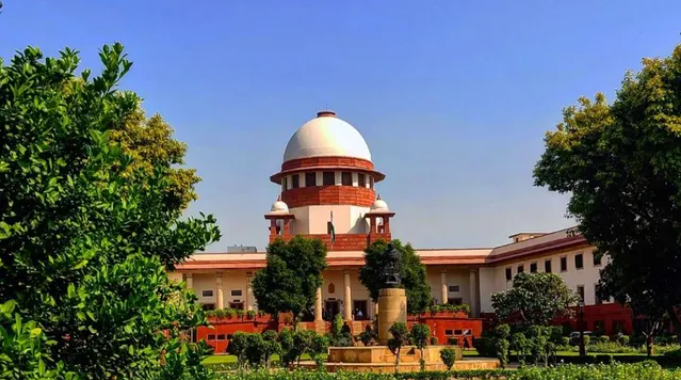
New Delhi: A fresh legal dispute over ageing diesel vehicles in the Delhi-NCR region has reached the Supreme Court.
The owner of a luxury Volvo XC60 diesel car has approached the court after allegedly being denied a Pollution Under Control (PUC) certificate, despite the vehicle reportedly clearing the required emission test.
The case raises questions about the implementation of vehicle-age restrictions through automated PUC systems.
Volvo Owner Challenges PUC Denial
According to the petition, the Volvo XC60 successfully passed the prescribed pollution test.
However, the owner claims that the computerized system at authorized PUC centres refused to generate a certificate because the diesel vehicle had crossed the applicable 10-year age threshold.
The petitioner has argued that the system should consider the vehicle’s actual emission performance rather than automatically blocking certification based on age.
Owner Claims Difficulty in Refuelling
The petitioner has also alleged that the absence of a valid PUC certificate has created practical problems.
According to the plea, some fuel stations have refused to provide diesel without a valid PUC certificate.
The owner argues that this has effectively restricted the use of the vehicle even though it reportedly cleared the emission test.
Supreme Court Hears the Matter
The issue was brought before a Supreme Court Bench headed by Chief Justice of India Justice Surya Kant.
Senior advocate Rakesh Khanna, appearing for the petitioner, reportedly argued that premium vehicles such as Volvo models are designed for long-term use.
He contended that a well-maintained vehicle should not automatically be treated as unsuitable solely because it has crossed a particular age.
The petition also raises concerns about whether an automated software rule can override the results of an actual pollution test.
What Does the Petition Say About PUC Software?
According to the petition, operators at PUC centres informed the vehicle owner that their software is programmed to prevent the issuance of certificates for certain diesel vehicles that have crossed the prescribed age limit.
As a result, the system allegedly blocks certificate generation even when the vehicle meets the required emission parameters.
The petitioner argues that this creates a gap between technical compliance and administrative implementation.
Supreme Court’s Earlier Orders on Old Vehicles
The case comes against the background of several Supreme Court and National Green Tribunal orders concerning ageing vehicles in Delhi-NCR.
In August 2025, the Supreme Court had directed that no coercive action be taken against owners of 10-year-old diesel and 15-year-old petrol vehicles while the matter was being considered.
However, in December 2025, the Supreme Court modified that position and allowed action against 10-year-old diesel and 15-year-old petrol vehicles that are below BS-IV emission standards.
This distinction between vehicle age and emission standard is important in understanding the current legal debate.
Why the Volvo Case Is Important
The petition could have wider implications for older vehicle owners in Delhi-NCR.
It raises several important questions:
- Should a vehicle that passes an emission test receive a PUC certificate?
- Can automated software reject certification solely because of vehicle age?
- How should court orders be implemented through PUC systems?
- Should emission standards and vehicle age be considered separately?
- Do existing software protocols need to be updated?
These questions could become important for other owners facing similar difficulties.
Legal and Environmental Issues
The dispute highlights the challenge of balancing air-pollution control with individual vehicle owners’ rights.
Delhi-NCR has historically followed strict restrictions on older diesel and petrol vehicles because of concerns over vehicular emissions.
At the same time, vehicle owners argue that emission testing provides a direct way to determine whether a particular vehicle meets pollution standards.
The Supreme Court’s eventual directions could provide greater clarity on how these requirements should interact.
What Happens Next?
The matter remains before the Supreme Court, and further directions are expected as the case progresses.
The court’s consideration could influence how PUC certification systems deal with older diesel vehicles and whether automated age-based restrictions require modification.
The outcome will be closely watched by vehicle owners, environmental authorities and transport officials across Delhi-NCR.