
New Delhi, Delhi
Following the commencement of operations along the entire Delhi-Meerut Namo Bharat corridor, significant changes are being witnessed in public transportation across the Delhi-NCR region. According to the National Capital Region Transport Corporation (NCRTC), nearly one lakh passengers are currently travelling on Namo Bharat trains every day. The increase in ridership is expected to reduce dependence on private vehicles and provide environmental benefits.
NCRTC Managing Director Shalabh Goyal said the reliability of the Namo Bharat service has been steadily improving. A large number of people are now using the service for their daily commute.
Residential Development Gains Momentum in Meerut
The impact of Namo Bharat is not limited to transportation. Many people who work in Delhi and live in areas such as Ghaziabad, Modinagar and Begumpul in Meerut are increasingly choosing to stay in their home cities.
Faster and more convenient transportation has made daily travel to and from Delhi easier. As a result, Meerut is emerging as an important residential centre. The trend is being viewed as a form of reverse migration, with people moving back from major metropolitan areas to surrounding cities.
New Urban Centres Emerging Around Stations
Transit-Oriented Development (TOD) is being promoted around stations along the Namo Bharat corridor. The concept has been incorporated into the Master Plans 2031 of Ghaziabad and Meerut.
Under TOD, residential and commercial activities, along with schools, hospitals and other essential facilities, are developed around major transportation hubs. This can reduce the need for people to travel long distances for their everyday requirements.
Environmental Benefits
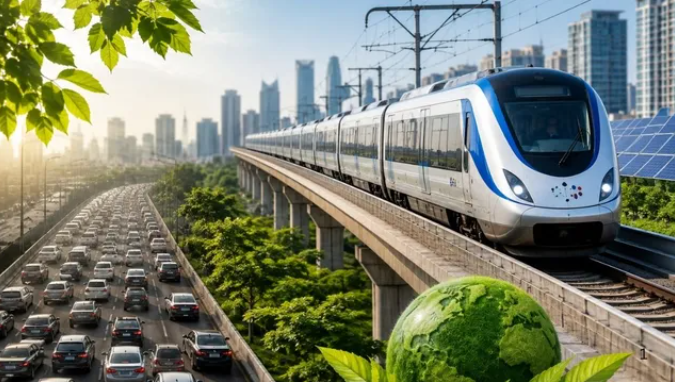
The increased use of public transportation can have a direct impact on the number of private vehicles on the roads. If a large number of commuters choose Namo Bharat instead of private cars and other vehicles, traffic pressure on roads can be reduced.
This can also help lower fuel consumption and vehicle-related emissions. For this reason, Namo Bharat is increasingly being viewed not only as a transportation initiative but also as a project with potential environmental benefits.
92% Indigenous Technology
The Namo Bharat corridor is also reported to use approximately 92% indigenous technology. In addition, solar energy is being used in the operation of the corridor.
This combination promotes both indigenous technology and clean energy. Namo Bharat is therefore emerging in Delhi-NCR not merely as a new rail service, but as an integrated project connecting transportation, urban development and environmental sustainability.