

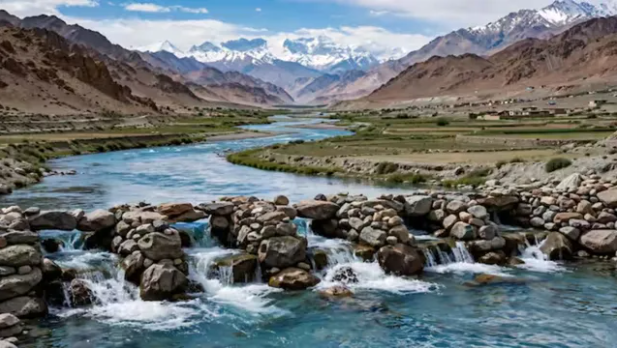
Leh, Ladakh
Amid the suspension of the Indus Waters Treaty, India has taken a significant step toward water conservation in Ladakh. A check dam has been constructed using natural stones in the Upshi area of Leh district. According to reports, no cement or concrete has been used in its construction. The structure has been designed to store water from the Indus River and channel it toward nearby dry and barren agricultural fields for irrigation.
According to available information, the construction of the check dam has resulted in an increase of around 10 feet in the river’s water level. It is reportedly capable of storing nearly 40 million litres of water. The stored water is being supplied to agricultural fields through an irrigation canal, providing access to water in areas where farming has long been affected by water shortages.
Check Dam Built Using Natural Stones
One of the key features of the check dam is that it was constructed without the use of cement or concrete. Natural stones have been carefully arranged to create a structure capable of slowing and storing water. The initiative makes use of locally available resources to conserve water and make it available for agricultural purposes.
Water availability has always been a major challenge in the high-altitude and arid region of Ladakh. In such conditions, creating additional sources of irrigation water is considered important for local farmers. The water accumulated behind the check dam can be used to irrigate surrounding agricultural land.
Significance Amid the Indus Waters Treaty Suspension
The Indus Waters Treaty has long served as the framework for water sharing between India and Pakistan. Following the Pahalgam terror attack, India announced the suspension of the treaty. Pakistan subsequently raised the issue at international forums.
Against this backdrop, the local use of water from the Indus River in Ladakh has gained significance from both strategic and agricultural perspectives. However, the primary objective of the check dam remains local water conservation and improving irrigation facilities.
The extent to which the stored water will provide long-term relief to agricultural fields in the Upshi region will become clearer over time. For now, the natural-stone check dam has emerged as a notable water-conservation initiative in the arid areas of Ladakh.