

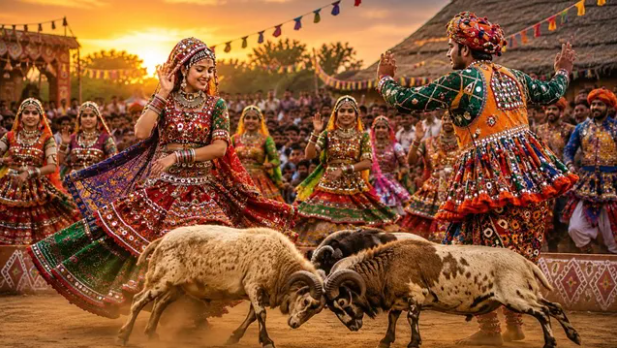
Ahmedabad, Gujarat: India’s folk culture has always shared a deep connection with nature, animals, birds and everyday human life. Across different parts of the country, numerous folk songs and dances have evolved from fascinating stories rooted in local traditions and the natural world. Gujarat’s ‘Hoodo’ folk dance is one such unique tradition. According to a popular local belief, the dance was inspired by two sheep fighting, and over time, this animal behaviour evolved into a form of community dance.
How Gujarat’s ‘Hoodo’ Dance Began With Two Fighting Sheep
Hoodo is traditionally associated with Gujarat’s Bharwad shepherd community. According to folk tradition, shepherds would closely observe two sheep as they charged toward each other, locked horns and repeatedly moved back and forth while fighting.
The rhythmic movements of the animals are believed to have caught the attention of the Bharwad community. People eventually began imitating the movements of the sheep. What started as a form of entertainment and a communal activity gradually incorporated rhythm, music and coordinated steps. Over time, these movements developed into a traditional folk dance known as ‘Hoodo’.
A Community Tradition Inspired by Animals
One of the defining features of Hoodo is that its significance goes beyond dance steps. It also reflects the rural lifestyle of the community from which it emerged. Animals have traditionally played an important role in the lives of pastoral communities, making their behaviour and movements a natural source of inspiration for folk traditions.
During the dance, performers face one another and move in coordinated patterns and rhythmic steps. The collective performance is visually engaging and also reflects the sense of unity and togetherness within the community.
A Dance Associated With a Swayamvar-Like Tradition
One of the most interesting aspects associated with Hoodo is its social significance. According to folk tradition, young men and women participated in the dance during certain traditional gatherings and celebrations. Such occasions reportedly provided young women with an opportunity to identify and choose potential life partners.
Because of this tradition, Hoodo has been viewed not merely as entertainment but also as a form of folk expression connected with social interaction and marriage customs. The gatherings allowed young people to observe, interact with and develop an understanding of one another, in a tradition that has often been compared to a swayamvar-like custom.
Still a Part of Gujarat’s Folk Identity
Although modern forms of entertainment have expanded considerably, Hoodo continues to hold a distinctive place in Gujarat’s folk culture. Performances can still be seen at traditional fairs, cultural programmes and folk festivals, where they attract considerable attention.
Hoodo is an example of how folk traditions can evolve from everyday life and the natural environment. A seemingly ordinary event such as two sheep fighting, according to the local folk belief, eventually inspired a cultural tradition that brings together music, dance, community life and social customs related to marriage.
This is why Gujarat’s Hoodo is regarded as more than just a folk dance. It offers a living glimpse into the centuries-old relationship between rural communities, animals and nature.