

New Delhi:
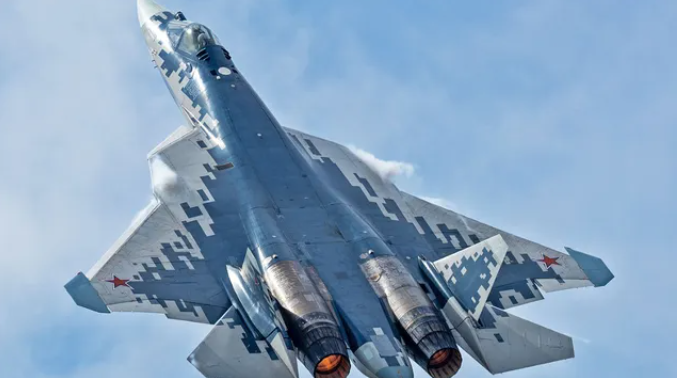
The debate over fifth-generation fighter jets for India’s air defence has intensified once again. Russia has offered India its advanced Su-57E stealth fighter jet. According to reports, Russia has also proposed manufacturing the aircraft in India under the ‘Make in India’ initiative and sharing technology related to its production.
The proposal comes at a time when there has been growing discussion about the possibility of Pakistan acquiring J-35 stealth fighter aircraft from China. This has raised an important question: Could the Russian Su-57 become India’s answer to the growing fifth-generation fighter capabilities of Pakistan and China?
Why Does India Need Fifth-Generation Fighter Jets?
The Indian Air Force has long emphasised the need for advanced fifth-generation fighter aircraft. India’s existing fighter fleet also includes several older platforms, while the importance of stealth, sensor fusion, network-centric operations and long-range weapons capabilities is steadily increasing in modern warfare.
India’s own AMCA (Advanced Medium Combat Aircraft) programme is a major step in this direction. However, the development and production of an indigenous fifth-generation fighter could take time. Therefore, discussions about considering a foreign platform such as the Su-57E as an interim option have become strategically significant.
What Is Russia’s ‘Make in India’ Proposal?
The most important aspect of Russia’s reported proposal is not simply the purchase of ready-made Su-57 aircraft, but the possibility of manufacturing the fighter in India.
Russia is offering greater local production and technological cooperation as part of its defence partnership with India. If such an agreement moves forward, India could potentially benefit from local capabilities in aircraft manufacturing, maintenance and related technologies.
However, in any potential agreement, the actual scope of Technology Transfer (ToT) would be crucial. Licensing terms, production rights and access to critical technologies such as engines and advanced avionics would need to be carefully evaluated.
Su-57 vs China’s J-35
The Su-57 is Russia’s fifth-generation stealth fighter, while China’s J-35 is also a new-generation fighter based on stealth technology.
The two aircraft have different design priorities and operational roles. The Su-57 has primarily been developed with air-superiority and multi-role missions in mind, while the J-35 is considered part of China’s broader family of fifth-generation combat aircraft.
If Pakistan eventually acquires J-35 fighters, the presence of fifth-generation combat aircraft in South Asia could become an important strategic issue for India.
Is the Su-57 a Direct Answer to the J-35?
Describing the situation simply as ‘Su-57 vs J-35’ would be an oversimplification. In modern aerial warfare, an aircraft’s stealth capability alone is not decisive. Radar systems, electronic warfare, missiles, data links, airborne early-warning systems, pilot training and network-centric warfare capabilities also play critical roles.
Therefore, if India adopts the Su-57E, its actual strategic impact would depend not only on the number of aircraft acquired but also on how effectively they are integrated with the broader Indian Air Force network.
What Will Happen to the AMCA Programme?
One of the biggest questions for India is what impact adopting the Su-57 as an interim capability could have on the indigenous AMCA programme.
One possible approach could be for India to address its immediate operational requirements through a foreign fifth-generation fighter while continuing the development of the AMCA. This could provide the Indian Air Force with modern stealth capabilities in the near term while allowing India to develop indigenous fighter technology over the long term.
However, issues such as cost, production timelines, technology transfer and strategic autonomy would require careful evaluation.
How Big a Decision Is This for India?
The Su-57 proposal is not simply about acquiring another fighter aircraft. It is a decision linked to strategic partnership, technological self-reliance and India’s future air-warfare capabilities.
If Russia genuinely offers extensive technology transfer, local manufacturing and significant industrial participation, the proposal could represent an important opportunity for India’s defence industry. At the same time, India would need to ensure that any interim acquisition does not slow down or undermine the indigenous AMCA programme.
For now, the biggest question surrounding the Su-57 is this: Will it become an interim solution to meet India’s immediate fifth-generation fighter requirement, or will India place its primary reliance on its indigenous AMCA programme? Defence discussions between India and Russia in the coming months could provide greater clarity on the direction India ultimately chooses.