

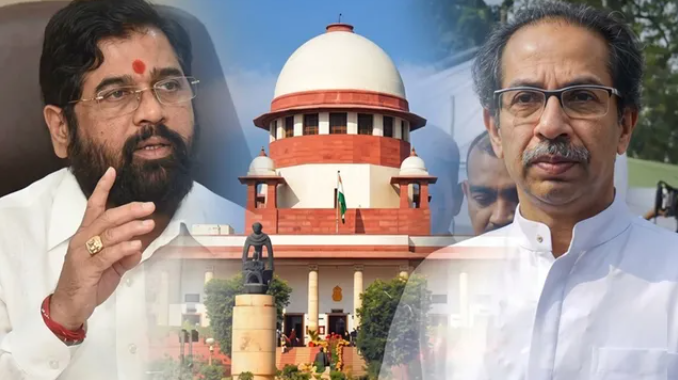
New Delhi: The Supreme Court of India has begun the final hearing in the long-running dispute over which faction is the “real” Shiv Sena and who has the legal right to use the party’s traditional ‘Bow and Arrow’ election symbol.
The case challenges the Election Commission of India’s (ECI) decision to recognize the Eknath Shinde-led faction as the official Shiv Sena and allot it the party’s historic election symbol.
Supreme Court Bench Hears the Case
The matter is being heard by a Bench comprising:
- Chief Justice Surya Kant
- Justice Joymalya Bagchi
- Justice V. Mohan
The verdict is expected to have significant implications for political parties, internal democracy, and the Election Commission’s powers in resolving party disputes.
Court Observations
During the hearing, the Bench observed that a political party continues to exercise authority over its legislative wing and that decisions made through the party’s authorized organizational structure deserve respect.
The court emphasized that the relationship between a political party and its elected representatives is fundamental to India’s parliamentary democracy.
Freedom of Legislators Has Limits
The Bench also noted that elected legislators may, under certain circumstances, have limited freedom to take political decisions, especially when a majority disagrees with the party leadership.
However, the judges clarified that any change in leadership or party direction must follow the organization’s constitution and established internal procedures.
Kapil Sibal’s Arguments
Senior advocate Kapil Sibal, appearing for the Uddhav Thackeray faction, argued that the Election Commission failed to properly consider the Shiv Sena’s party constitution while deciding the dispute.
According to Sibal, determining the identity of a political party solely on the basis of the numerical strength of legislators ignores the importance of the party’s organizational framework and constitutional structure.
He further argued that office-bearers, party workers, the party constitution, and internal decision-making mechanisms are equally important in deciding which group legitimately represents the original political party.
Background of the Dispute
The legal battle began after the split in Shiv Sena following Eknath Shinde’s rebellion in 2022.
The Election Commission later recognized the Shinde faction as the official Shiv Sena and allotted it the ‘Bow and Arrow’ election symbol.
The Uddhav Thackeray faction challenged this decision before the Supreme Court, arguing that the Commission’s decision was legally flawed.
Why the Case Matters
Legal experts believe the Supreme Court’s verdict could establish important principles regarding:
- Political party ownership
- Internal party democracy
- Legislative majority versus organizational control
- Election Commission’s powers
- Future party split disputes
The judgment is expected to influence how similar political disputes are handled in the future.
Final Decision Awaited
The hearing is continuing, and the Supreme Court’s final verdict is expected to have far-reaching consequences for the Shiv Sena dispute and India’s broader constitutional and electoral framework.