

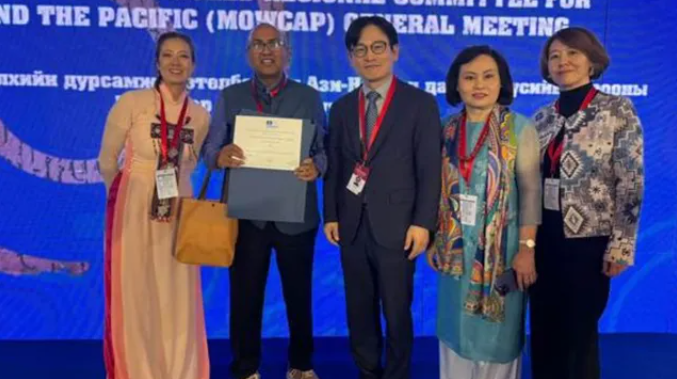
This recognition has brought India’s rich historical and intellectual heritage into greater international focus.
All three works hold immense importance in Indian society, culture, and historical studies. They contain valuable insights into religion, governance, politics, economics, philosophy, and fundamental human values.
Mahabharata: An Important Work of Indian Culture and Philosophy
The Mahabharata is regarded as one of the most significant epics in Indian literature. Through the conflict between the Kauravas and the Pandavas, it explores important themes such as Dharma, justice, duty, and morality.
The Bhagavad Gita, one of the most influential spiritual and philosophical texts in India, is also part of this epic.
The Mahabharata plays an important role in understanding India’s religious, cultural, and philosophical traditions.
Kautilya’s Arthashastra: A Document of Ancient Governance
Acharya Kautilya’s Arthashastra is an important source for understanding ancient India’s political, administrative, and economic systems.
The text discusses several aspects of state administration, including taxation, security, diplomacy, economic management, and governance.
It provides valuable insights into the political and administrative thinking of ancient India and remains an important reference for researchers studying the history of governance.
Rajatarangini: An Important Historical Record of Kashmir
Written by Kalhana in the 12th century, Rajatarangini is a significant historical work documenting the history of Kashmir.
It contains accounts of various rulers, dynasties, and important political developments in the region.
For historians, this work has served as an important source for understanding Kashmir’s historical traditions, political transformations, and royal lineages.
India’s Entries in the UNESCO Regional Register Rise to Six
The Ministry of Culture’s Press Information Bureau (PIB) shared images of UNESCO certificates on the social media platform X, announcing this achievement.
The ministry described the recognition as a proud moment for India’s rich civilizational heritage.
With the inclusion of these three works, India’s total number of entries in the Memory of the World Asia-Pacific Regional Register has increased to six.
The Indira Gandhi National Centre for the Arts (IGNCA) also played an important role in this process.
Recognition Expected to Strengthen the Preservation of Ancient Manuscripts
The UNESCO regional register aims to identify, preserve, and highlight historically significant documents and manuscripts.
The recognition given to the Mahabharata, Arthashastra, and Rajatarangini is expected to encourage greater international interest in the study and preservation of India’s traditional knowledge systems.
This achievement highlights India’s remarkable historical legacy, which has contributed to the development of literature, politics, philosophy, and social thought over several centuries.