

Mumbai, Maharashtra:
Today, Indian Railways is an essential part of the daily lives of millions of people across the country. Whether it is long-distance travel or commuting to work every day, trains remain one of the most accessible and affordable modes of transportation for ordinary Indians. But did you know that when India’s first passenger train ran on the tracks, its journey was nothing short of a historic event?
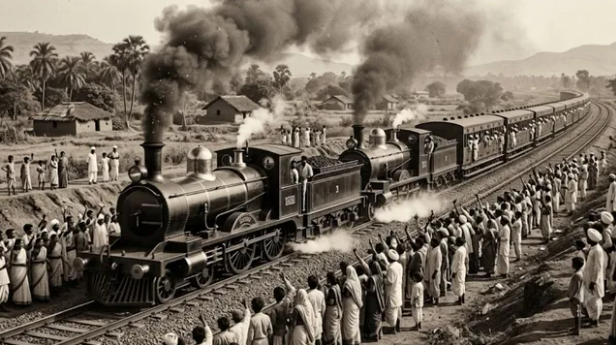
India’s first passenger train ran on April 16, 1853. It departed from the then Bori Bunder Station in Mumbai and travelled to Thane. The train was hauled by three steam locomotives—Sahib, Sindh and Sultan. This historic journey marked the beginning of a new era of rail transportation in India.
Train Departed With 400 Passengers
April 16, 1853, is considered one of the most significant dates in the history of Indian Railways. At around 3:35 pm, the first passenger train departed from Bori Bunder for Thane. Approximately 400 passengers were on board.
At that time, travelling by train was far from being a normal experience. The technology was entirely new to people. Large crowds gathered along the route to witness the steam-powered train. As the train began its journey, a new chapter in the history of transportation in India was opened.
Three Steam Engines Hauled the First Train
One of the most remarkable features of India’s first passenger train was that it was hauled not by one, but by three steam locomotives. They were named Sahib, Sindh and Sultan.
Together, the three locomotives covered the approximately 34-kilometre distance from Bori Bunder to Thane. The journey took around 75 minutes to complete.
By today’s standards, taking 75 minutes to cover 34 kilometres may seem like a long time. However, in 1853, it was a remarkable technological achievement. For the first time, the railway provided passengers travelling between Mumbai and Thane with a faster and relatively convenient transportation option.
Received a 21-Gun Salute
The historic journey of the first passenger train was marked by a formal ceremony. At the time of the train’s departure, it was given a 21-gun salute.
During that era, the railway was not merely a means of transportation. It was also seen as a symbol of modern technology and industrial transformation. The successful operation of the first passenger train paved the way for the rapid expansion of the railway network across India.
Deccan Queen Was Not India’s First Train
There is often a misconception that India’s first train was the Deccan Queen. This is incorrect.
The Deccan Queen is one of Indian Railways’ most famous and historic trains, but it was not the first passenger train to operate in India in 1853. India’s first passenger train ran on April 16, 1853, between Bori Bunder and Thane.
Therefore, while recounting the history of India’s railways, it is important to distinguish between the Deccan Queen and the first passenger train as two separate milestones.
Railway System Began During British Rule
The railway system in India was introduced during British rule. In its early years, the development of railways was also driven by administrative and commercial interests. Connecting ports and major trading centres made it easier to transport goods and people.
Over time, however, the railway became an integral part of Indian society and the economy. It played a crucial role in connecting different parts of the country, and after independence, the Indian railway network continued to expand significantly.
A Historic Turning Point in a 75-Minute Journey
The approximately 75-minute journey from Bori Bunder to Thane in 1853 may seem short by today’s standards, but its impact was enormous. The journey hauled by three locomotives—Sahib, Sindh and Sultan—eventually laid the foundation for India’s vast railway network.
Today, Indian Railways extends to even the most remote parts of the country. Millions of people travel by train every day, while railways also play a major role in freight transportation.
That is why the 75-minute journey on April 16, 1853, was not merely a train ride—it was a historic moment that marked the beginning of modern rail transportation in India.