

Sriharikota, Andhra Pradesh
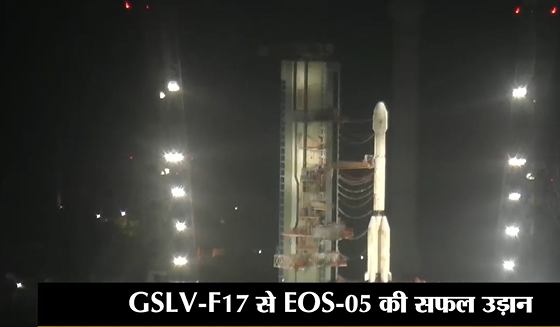
India has achieved another significant milestone in the space sector. The Indian Space Research Organisation (ISRO) successfully launched the EOS-05 imaging satellite from the Satish Dhawan Space Centre in Sriharikota early Friday morning. The satellite was carried into space aboard the GSLV-F17 rocket at 2:55 a.m. Approximately 22 minutes after liftoff, the mission director announced that the mission had been successfully completed.
ISRO Chairman V. Narayanan, along with several senior scientists and former organisation heads, was present during the mission. Following the successful launch, scientists and mission officials congratulated one another on the achievement.
Earth Observation from Geosynchronous Orbit
EOS-05 has been developed as an advanced Earth observation imaging satellite. It is designed to capture images of the Earth from a geosynchronous orbit. The satellite was initially placed into a sub-geosynchronous transfer orbit and will subsequently be moved to its designated final orbit through planned orbital manoeuvres.
Once it reaches its operational orbit, the satellite will be capable of repeatedly imaging and monitoring large areas of the Earth. This will enhance India’s ability to obtain important information about the Earth’s surface and related activities.
EOS-05 reportedly weighs approximately 2,367 kilograms. The mission was carried out as a dedicated launch by New Space India Limited (NSIL) for a strategic user. In addition, 18 co-passenger satellites from India and other countries were launched as part of the mission.
19th Flight of GSLV-F17
The launch of EOS-05 marked the 19th flight of the GSLV-F17 rocket. The vehicle is approximately 51.7 metres long and has a lift-off mass of around 420.5 tonnes. It was launched from the Second Launch Pad at the Satish Dhawan Space Centre.
The upper section of the rocket was equipped with an ogive composite payload fairing measuring approximately four metres in diameter. EOS-05 was securely housed inside the fairing, which protected the satellite as the vehicle passed through the Earth’s atmosphere during launch.
ISRO Chief Congratulates Scientists
Following the successful mission, ISRO Chairman V. Narayanan congratulated the scientists and the entire mission team. He said the launch marked ISRO’s 107th mission from Sriharikota.
He noted that the GSLV-F17 has undergone continuous improvements and technological upgrades. The ISRO chief also highlighted the important contribution of the Indian space industry to the mission’s success. He acknowledged the support and contribution of the families of the scientists as well.
Mission Director Thomas Kurian and other scientists also expressed their happiness over the successful mission and congratulated the people of India. The scientists concluded the celebrations by raising the slogan “Jai Hind.”
Important for Both Strategic and Scientific Purposes
The successful deployment of EOS-05 is being viewed as an important step toward strengthening India’s Earth observation and space-based monitoring capabilities. The ability to conduct regular Earth imaging from a geosynchronous orbit could prove valuable not only for scientific research but also for strategic requirements.
The successful flight of GSLV-F17 once again demonstrates India’s indigenous launch capabilities and growing expertise in space technology. The imaging capabilities provided by EOS-05 could play an important role in Earth monitoring and the study of various activities and changes occurring on the planet in the years ahead.