

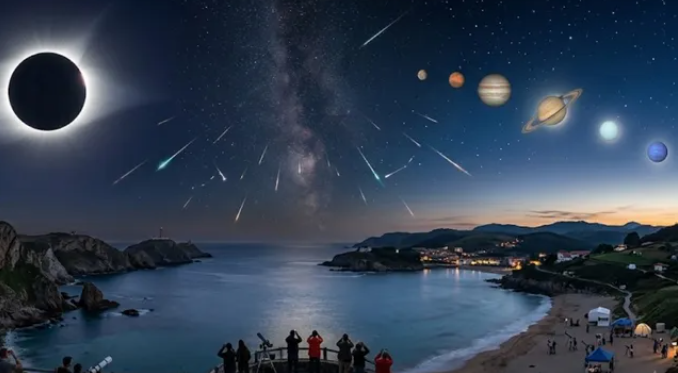
New Delhi, Delhi: August 12, 2026, is set to be a particularly exciting date for astronomy enthusiasts, with three major celestial events occurring within roughly 24 hours. Before sunrise, several planets will be visible across the sky; during the day, a total solar eclipse will take place; and at night, skywatchers will have the opportunity to observe the Perseid meteor shower. The close occurrence of these three events makes the date a remarkable period for stargazers.
Several Planets to Appear Before Sunrise
On the morning of August 12, several planets will be visible approximately 30 to 60 minutes before sunrise. The planetary lineup will include Mercury, Mars, Jupiter, Saturn, Uranus and Neptune.
Among them, Mars, Jupiter and Saturn may be visible to the naked eye under favourable viewing conditions. Uranus and Neptune are much fainter and may require binoculars or a telescope. Visibility of Mercury will also depend heavily on the observer’s location and how clear the eastern horizon is.
The appearance of several planets within the same broad region of the sky will offer an interesting sight for astronomy enthusiasts. However, the planets will not necessarily form a perfectly straight line. Instead, they will appear along a broad band of the sky.
Total Solar Eclipse During the Day
Later on August 12, a total solar eclipse will also occur. According to available information, the path of totality will pass through areas including Greenland, Iceland and parts of Europe. Some areas of northern Spain and Portugal may also experience totality.
During totality, the Moon will completely cover the Sun for a short period, causing the sky to become noticeably darker along the path of the eclipse. Around Iceland, the duration of totality is expected to be approximately 2 minutes and 18 seconds.
The eclipse will also be visible in partial form from parts of Europe, Canada and northern regions of North America.
Experts have urged people to take proper precautions while observing the solar eclipse. Looking directly at the Sun can cause serious and permanent eye damage. Only certified solar-viewing glasses or approved solar filters should be used. Ordinary sunglasses are not safe for viewing a solar eclipse.
Perseid Meteor Shower to Light Up the Night
The night of August 12 will bring another major attraction for skywatchers as the Perseid meteor shower remains active.
Under clear skies and away from significant light pollution, bright meteors may streak across the night sky. Relatively favourable lunar conditions this year may also help observers spot more meteors.
During the peak, a large number of meteors can potentially be visible per hour under ideal conditions. However, the actual number observed will depend on the location, weather conditions, light pollution and the observer’s view of the sky.
A Special Date for Stargazers
With a planetary gathering before sunrise, a total solar eclipse during the day and the Perseid meteor shower at night, August 12, 2026, is shaping up to be an especially interesting date for astronomy enthusiasts.
However, visibility of these events will vary significantly depending on location. Skywatchers should therefore check their local timings, weather conditions and visibility forecasts before planning their observations.