

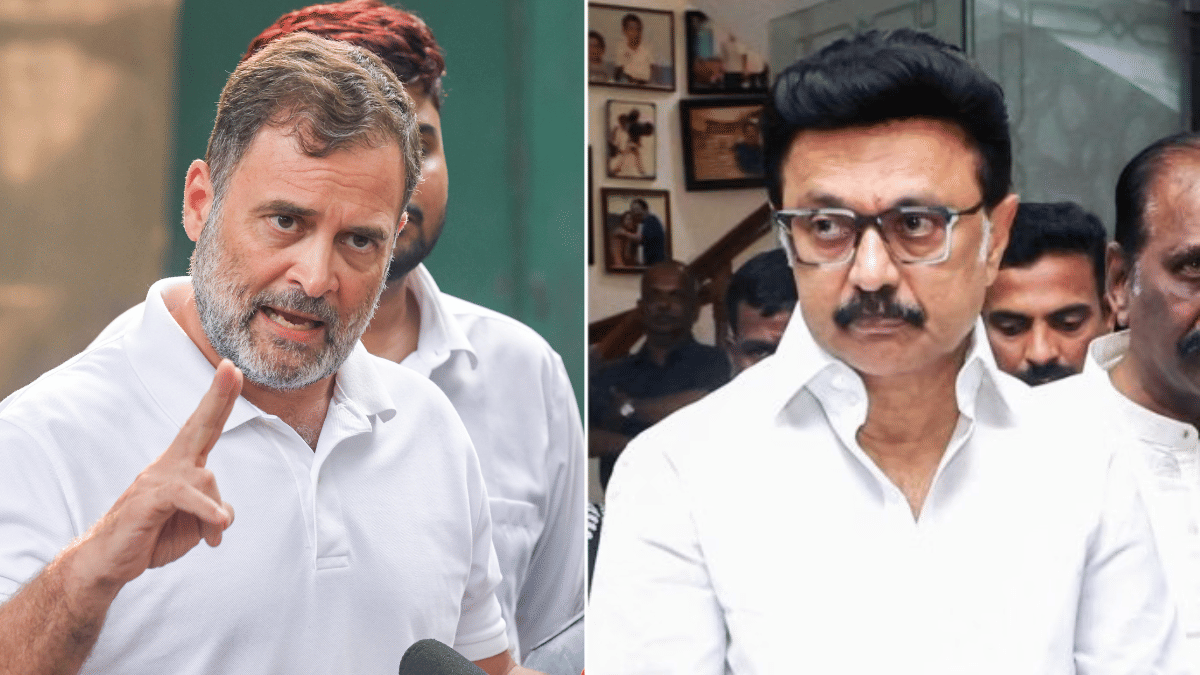
The Dravida Munnetra Kazhagam (DMK) has criticized Congress leader Rahul Gandhi for his silence and contradictory position regarding the deletion of voter names in English Nadu. This comes amid ongoing protests in Delhi against the Special Intensive Revision (SIR) exercise that removed millions from the electoral rolls.
DMK Questions Rahul Gandhi’s Silence on Voter Deletions
DMK spokesperson Saravanan Annadurai took to X to openly challenge Rahul Gandhi about his stance on the deletion of voter names in English Nadu. Despite the opposition INDIA bloc’s protest in Delhi targeting Chief Election Commissioner Gyanesh Kumar over the SIR exercise, Rahul Gandhi remained quiet.
Annadurai specifically questioned why Rahul did not support Congress president Mallikarjun Kharge’s statement that governments elected after the SIR process should be considered illegal. He implied Rahul’s reluctance to speak was due to pressure from actor-politician Vijay and the Tamilaga Vettri Kazhagam (TVK), adding a sharp critique: “What a duplicitous man? Once a skunk, always a skunk.”
Growing Rift Between DMK and Congress in English Nadu
Tensions between the DMK and Congress have risen notably following the 2026 Assembly elections, in which DMK lost power. The Congress ended a decades-long alliance with DMK in May 2026, which added fuel to the friction.
What’s the stand of @RahulGandhi with regard to the deletions through SIR in TN.
Why is he not endorsing Kharge jis statement that all State Governments elected after SIR should be dissolved?
Is he afraid of @actorvijay to speak about SIR in Tamilnadu.
What a duplicitous… https://t.co/fbjQOsZDuI— Saravanan Annadurai (@saravofcl) October 6, 2026
Details of the SIR Process and Its Impact
The SIR process was conducted before the 2026 state elections and led to the deletion of approximately 97.3 lakh names from draft electoral rolls. The electorate shrank from about 6.41 crore to 5.43 crore. Most deletions—66.4 lakh—were voters marked as shifted or absent, 26.9 lakh as deceased, and about 4 lakh duplicates.
Chennai experienced over 14 lakh deletions, accounting for more than 35 percent of its pre-SIR electorate in some estimates. Kolathur, the constituency of DMK leader and former Chief Minister M.K. Stalin, had about 1.03 lakh voter names removed.
DMK’s Opposition and Legal Challenge to SIR
The DMK initially opposed the SIR exercise, citing the short timeline and the risk of disenfranchising valid voters. Stalin instructed party workers to verify deletions at the booth level, especially for DMK supporters.
In November last year, the DMK filed a petition with the Supreme Court against the SIR. However, the apex court closed all related petitions, including DMK’s, in July.
Claims of Political Impact and Congress Response
Stalin has linked part of his party’s electoral loss to the SIR-related deletions, alleging a conspiracy that aided rivals like the TVK. Meanwhile, Congress leaders in English Nadu, including P. Chidambaram, have raised concerns about the number of removals under the shifted or absent categories and called for verification.
Though Congress has campaigned against SIR nationwide—demanding restoration of deleted names, a halt to the process, and accountability from the Election Commission and central government—Rahul Gandhi’s silence regarding deletions in English Nadu has invited criticism from the DMK.