

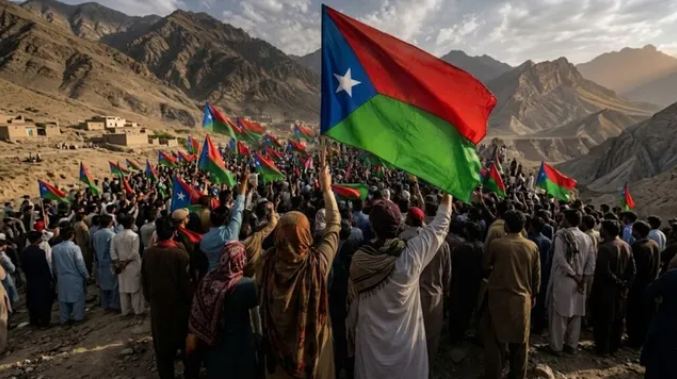
Balochistan, Pakistan: Baloch nationalist groups and their supporters observed August 11 as a symbolic “Independence Day” in parts of Balochistan, just three days before Pakistan’s official Independence Day on August 14.
The observance is linked to the history of the former princely state of Kalat and the competing narratives surrounding Balochistan’s relationship with Pakistan.
Baloch nationalist groups argue that the region had a distinct political identity before its incorporation into Pakistan and maintain that the process through which Kalat became part of Pakistan was not voluntary. Pakistan, however, considers Balochistan an integral part of the country.
According to claims by Baloch activists, authorities imposed restrictions in several areas to prevent gatherings linked to the commemoration. Internet and mobile services were also reportedly disrupted in some parts of the province, making it difficult for photographs and videos of the events to emerge immediately.
Restrictions Reportedly Imposed in Several Areas
Baloch human rights activist and nationalist leader Mir Yar Baloch alleged that communication services were disrupted in areas including Kalat, Quetta and Khuzdar.
He also claimed that security arrangements were strengthened around military installations and police stations, while aerial surveillance was reportedly conducted in some locations.
Despite the reported restrictions, Baloch nationalist supporters reportedly organised small gatherings and other activities in different areas to mark August 11.
Activists described the observance as an expression of their demand for political freedom and a reminder of what they regard as the disputed incorporation of Balochistan into Pakistan.
Why Is August 11 Significant?
August 11 has particular significance in Baloch nationalist politics because of the history of the Khanate of Kalat.
Before the creation of Pakistan in 1947, Kalat was a princely state in the region that now forms a significant part of Balochistan.
Baloch nationalist groups maintain that Kalat declared independence on August 11, 1947, shortly before Pakistan came into existence. They therefore regard the date as a symbolic independence day for Balochistan.
However, the historical circumstances surrounding Kalat’s accession to Pakistan remain highly contested.
Baloch nationalists describe the eventual incorporation of Kalat into Pakistan in 1948 as coercion or annexation, while Pakistan’s official position differs and regards the accession and subsequent integration as part of the formation of the Pakistani state.
The competing interpretations of this history remain central to Baloch nationalist politics.
Observance Comes Ahead of Pakistan’s August 14 Celebrations
The August 11 commemoration carries additional political significance because it takes place only three days before Pakistan celebrates its Independence Day on August 14.
For Baloch nationalist groups, observing August 11 separately is intended to highlight their claim that Balochistan has a distinct national identity and a separate historical trajectory.
Pakistan, meanwhile, continues to regard Balochistan as an integral province of the country.
The province has faced a long-running insurgency involving several armed Baloch groups. It has also been the subject of allegations concerning enforced disappearances, human rights violations and restrictions on political activity.
Pakistani authorities have repeatedly emphasised security concerns and accused militant organisations of carrying out violence and attacks.
These competing political and security narratives have made nationalist demonstrations and symbols particularly sensitive in Balochistan.
India Referenced by Baloch Activists
According to the report, Mir Yar Baloch also expressed gratitude towards India for raising the issue of Balochistan internationally.
Baloch nationalist activists have previously sought international attention regarding allegations of human rights violations and their political demands.
However, statements made by individual activists should be distinguished from independently verified facts. Reports concerning gatherings, security deployments and communication restrictions can be difficult to independently confirm, particularly when internet and mobile services are disrupted.
A Symbolic and Contested Observance
The August 11 events represent more than a conventional independence celebration. For Baloch nationalists, the date serves as a political and historical symbol of self-determination and opposition to Pakistan’s official interpretation of Balochistan’s accession.
Pakistan, on the other hand, continues to recognise Balochistan as an integral part of the country and officially celebrates August 14 as Independence Day.
The contrasting observances on August 11 and August 14 reflect the deep historical and political dispute that continues to shape Balochistan’s relationship with the Pakistani state.