

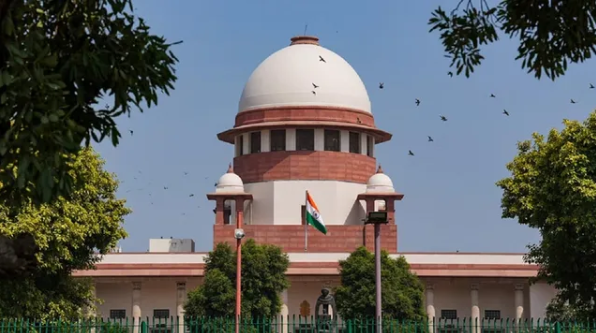
New Delhi: The Supreme Court has quashed an FIR and subsequent criminal proceedings against a Border Security Force (BSF) personnel in a dowry death case registered in Meerut, Uttar Pradesh.
A bench comprising Justice Sanjay Karol and Justice Augustine George Masih allowed the appeal filed by the BSF employee and set aside a December 2025 order of the Allahabad High Court, which had earlier refused to terminate the criminal proceedings against him.
The case dates back to 2016, when the dowry death case was registered in Meerut. The BSF personnel approached the Supreme Court after the High Court declined to interfere with the proceedings.
BSF Commandant’s Certificate Becomes Key Evidence
During the hearing, the Supreme Court examined a certificate issued by the Commandant of the BSF battalion where the appellant was serving.
According to the certificate, the BSF personnel had been officially deployed outside Meerut during the relevant period and was away from the city on government duty when the incident allegedly occurred.
The document became a significant part of the defence case because it directly concerned the appellant’s presence at the time of the alleged offence.
After examining the material placed before it, the Supreme Court concluded that allowing the criminal proceedings against the appellant to continue would amount to an abuse of the process of law.
The bench therefore exercised its jurisdiction to prevent the continuation of proceedings that, in its view, were not justified by the evidence available on record.
Court Examines Other Circumstances
The Supreme Court also considered other circumstances highlighted during the proceedings.
According to the submissions before the court, the parents of the accused had already been acquitted in connection with the case.
The bench also considered questions relating to the physical circumstances of the room where the incident allegedly took place, including details concerning the condition of the room and its door.
These aspects were examined alongside the official duty certificate issued by the BSF Commandant.
The court considered the overall circumstances while determining whether the criminal proceedings against the appellant should be allowed to continue.
Allahabad High Court Order Set Aside
The Supreme Court’s decision came after the Allahabad High Court’s December 2025 order, which had declined to terminate the proceedings against the BSF employee.
By allowing the appeal, the Supreme Court set aside the High Court’s order and quashed the FIR and criminal proceedings arising from it against the appellant.
As a result, the criminal case against the particular BSF personnel will no longer proceed on the basis of the FIR challenged before the Supreme Court.
The decision is based on the specific facts and evidence presented in this case and does not amount to a general ruling concerning dowry death prosecutions.
Supreme Court Highlights Importance of Evidence
The ruling underscores the principle that criminal proceedings should not continue when the material available on record indicates that doing so would amount to misuse or abuse of the legal process.
At the same time, allegations involving dowry-related deaths are serious and are governed by stringent legal provisions. Courts examine the circumstances surrounding the death and the specific evidence against each accused before deciding whether criminal proceedings should continue.
In this case, the circumstances concerning the BSF personnel’s alleged presence at the time of the incident were particularly significant.
The BSF Commandant’s certificate, indicating that the employee was outside Meerut on official duty during the relevant period, provided important evidence in his favour.
After considering the overall material, the Supreme Court concluded that continuing the prosecution against the appellant would amount to an abuse of the process of the court.
The ruling brings the criminal proceedings against the BSF employee arising from the challenged FIR to an end and highlights the importance of examining the evidence against each accused individually before requiring them to undergo a prolonged criminal trial.