

Summary: The Kannada author Ravi Hanj has been detained and faces multiple cases after Karnataka authorities arrested him at the Kochi airport, following a look-out circular issued by police over his book on Basavanna. The government has moved to confiscate copies and pursue legal action while protesters target the author and publisher.
What is happening
The controversy over Kannada author Ravi Hanj’s book on Basavanna has reopened a long-running debate in Karnataka over the 12th-century reformer’s legacy, the identity of Lingayats and Veerashaivas, and competing interpretations of his teachings. It has also drawn in Karnataka’s Congress government, which has reacted with a crackdown.
Arrest and legal action
On Saturday, Hanj was detained at Kochi International Airport while trying to leave the country. The airport security notified Karnataka Police since the latter had earlier issued a Look Out Circular (LOC) for Hanj. The author was then brought to Bengaluru, arrested and now faces several cases, including in Belagavi.
Contents of the book and reactions
“Veerashaivas and Lingayats are the same… The followers of Basavanna are called ‘Lingahathas’ and not ‘Lingayats’… Basavanna emptied King Bijjala’s treasury and used it for charity… The Sharana literature—Basavanna’s teachings—is full of contradictions!” These are some of the statements and writings in Chicago-based Ravi Hanj’s 600-page book, Basava Mantapa, that have sparked intense uproar in various quarters, drawing scrutiny and criticism for allegedly distorting the reformer’s works and teachings.
Government response
The Congress government led by D.K. Shivakumar was quick to decide on confiscating copies of the controversial book from stands and filing police complaints against Hanj and the publisher.
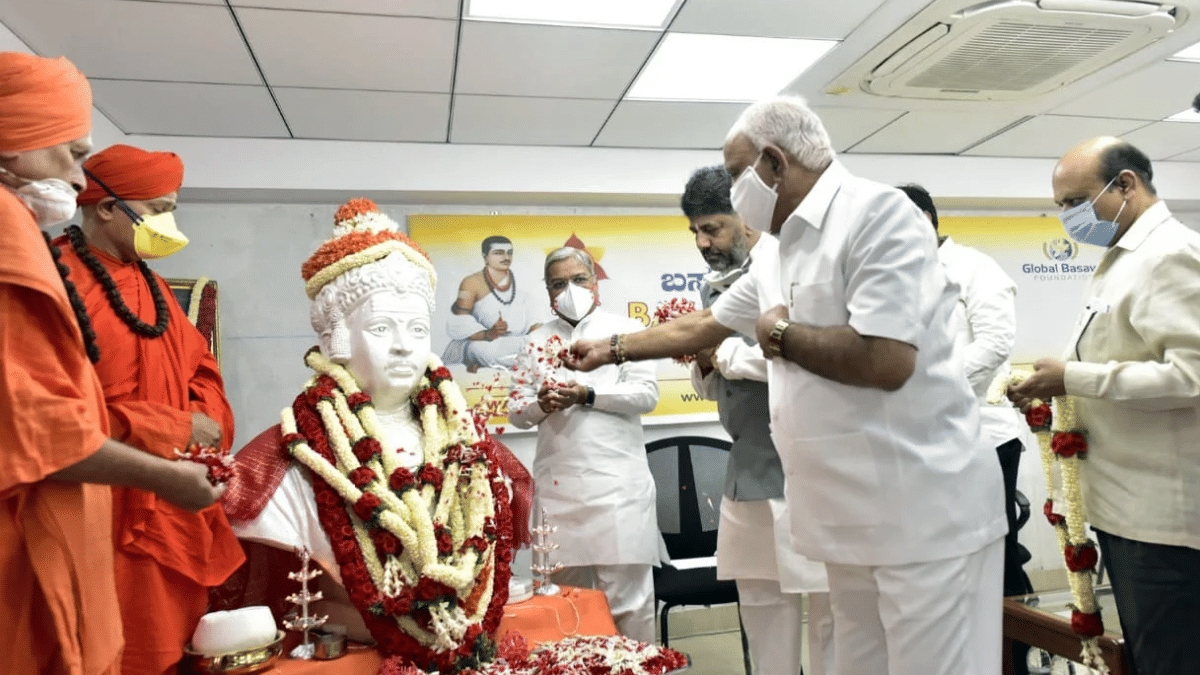
“The government will not remain silent if the honour of our Basavanna is violated. However, it is condemnable that an author named Ravi Hanj has written a controversial book titled ‘Basava Mantapa’ and has insulted Basavanna in a very derogatory manner. Our government will not tolerate this insult to a great social reformer who was a beacon for the entire human race,” Shivakumar said in a post Friday.
“ನಮ್ಮ ಬಸವಣ್ಣನವರ ಗೌರವಕ್ಕೆ ಧಕ್ಕೆಯಾದರೆ ಸರ್ಕಾರ ಸುಮ್ಮನಿರಲ್ಲ”
ಕರ್ನಾಟಕದ ಸಾಂಸ್ಕೃತಿಕ ನಾಯಕ, ಕ್ರಾಂತಿಕಾರಿ ಮಾರ್ಗದ ಹರಿಕಾರ ಜಗಜ್ಯೋತಿ ಬಸವಣ್ಣನವರು ನಮ್ಮೆಲ್ಲರ ಅಸ್ಮಿತೆ. 12ನೇ ಶತಮಾನದಲ್ಲಿಯೇ ಕರ್ನಾಟಕದ ಸಾಮಾಜಿಕ, ಧಾರ್ಮಿಕ ಹಾಗೂ ಸಾಂಸ್ಕೃತಿಕ ಇತಿಹಾಸಕ್ಕೆ ಹೊಸ ದಿಕ್ಕು ನೀಡಿದ ಮಹಾನ್ ಚೇತನರು.
ಜಗತ್ತಿಗೆ ಮೊಟ್ಟಮೊದಲ ಬಾರಿಗೆ… pic.twitter.com/NoiElKpaXq
— DK Shivakumar (@DKShivakumar) November 20, 2026
Public reaction and context
While the state government is confiscating all copies of the book from stands, protesters have publicly torn and burnt pages in protest against the author and publisher, prominent Kannada newspaper editor Vishweshwar Bhat.
The issue has united various factions within the community that are usually divided by politics, ideology and different schools of thought. These include leaders such as B.S. Yediyurappa, who has resisted attempts to classify Lingayats as a separate minority religion.
Lingayats are among Karnataka’s most dominant communities and are believed, according to their own estimates, to account for around 15-17 percent of the state’s population. They are a major bargaining bloc, politically and socially.
Other statements and clarifications
Reacting to Hanj’s arrest, Karnataka Industries Minister M.B. Patil told the media in Bengaluru, “Basava-hater Ravi Hanj’s deceit exposed; handed over to the police!”
A Lingayat himself, Patil added, “He (Hanj) had claimed to be in America and said that if he had known about the protests taking place in Karnataka, he would have stayed here and responded. His arrest by the police at Kochi airport in Kerala has exposed the truth behind his claims. The illusion that he could get away with lying has now been shattered! If he has told so many lies right here, what other lies might he have woven into his work?”
Not the first time
For decades, a section of Lingayats has pursued attempts to formally delink itself from the Hindu faith. Its members have also consciously tried to distinguish themselves from ‘Veerashaivas’—a term that is sometimes used interchangeably with Lingayats—as they believe the latter are either a sub-sect or a Hinduised version of the community.
On the eve of the 2018 Karnataka Assembly elections, then chief minister Siddaramaiah accorded minority religion status to Lingayats and made a clear distinction between them and Veerashaivas. However, the move was projected by the Yediyurappa-led Bharatiya Janata Party (BJP) as an attempt to divide the Hindu vote bank.
This is also not the first attempt to appropriate Basavanna’s legacy. In November 2024, intellectuals were up in arms over ‘Vachana Darshana‘, published by RSS-affiliated think tanks Ayodhya Publications and Prajna Pravah, which argued that Basavanna’s teachings had been “misinterpreted” by Leftist thinkers and the Jawaharlal Nehru University (JNU) fraternity.
To counter these claims, author Meenakshi Bali released a 60-page book, ‘Vachana Nija Darshana (The True Teachings of Basavanna)‘, challenging the arguments made in the RSS-backed publication. Among other things, the publication claimed that Basavanna’s teachings, or Vachanas, were an extension of Vedic teachings—a characterisation criticised as running counter to the social reformer’s beliefs.
The controversial book was released by BJP national general secretary (Organisation) B. L. Santosh in August 2024. It was viewed and criticised as an extension of a wider Hindutva push in education, particularly after the Basavaraj Bommai-led BJP government attempted to change school textbook syllabi in 2022.
Under Bommai, the Rohit Chakrathirtha-led revision committee came under intense scrutiny for changes made to textbooks from Classes 6 to 10, including nuanced edits and carefully crafted changes that selectively removed references to various historical personalities. This was alleged to be part of an attempt to co-opt them into Hinduism.
“In Bharata (India), Jews, Christianity and Islam are the only ones that can be called religions. Buddhism, Jainism and various traditions (Sampradaya) are different from religion. They can be distinguished and identified as believers and non-believers in them. Those traditions (Sampradaya) that believe in the Vedas are called theist traditions. Those that do not believe in the Vedas are non-believers or atheists. Dharma refers to a concept of a way of life,” said a revised textbook at the time.
(Edited by Viny Mishra)
Key points
- Ravi Hanj arrested at Kochi airport over his book on Basavanna.
- Kingdom-wide confiscation of copies and police complaints against the author and publisher.
- Controversy centers on Basavanna’s teachings and Lingayat–Veerashaiva identity debates.