

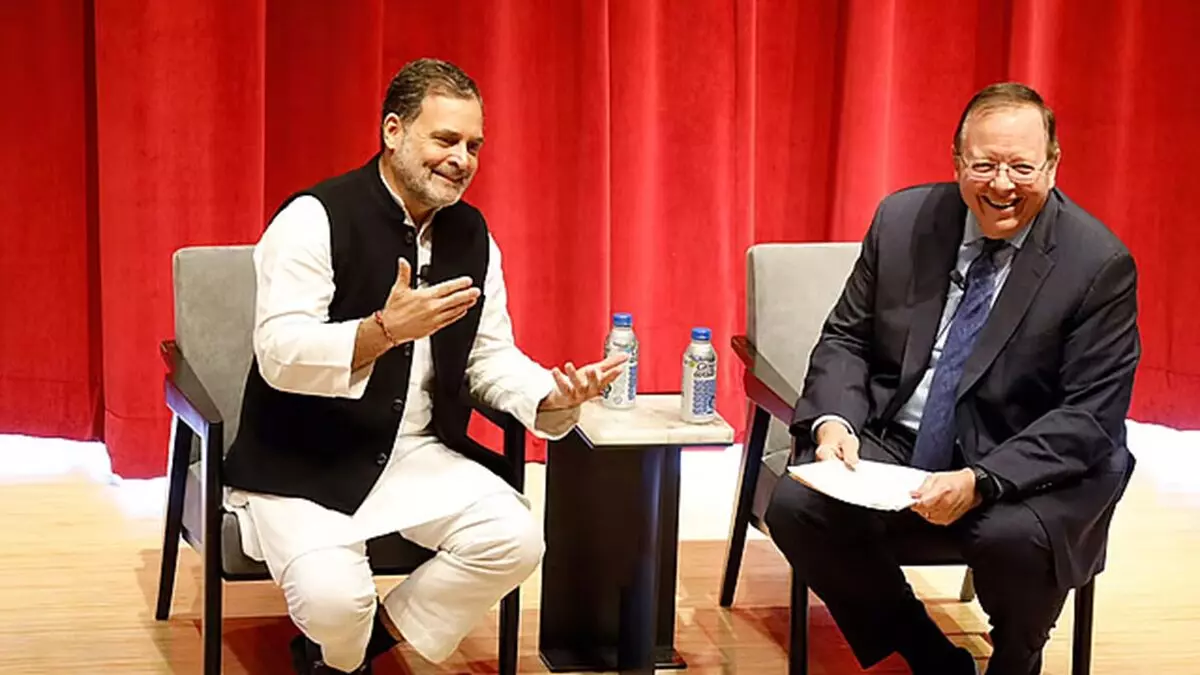
During a two-day visit to the United States, senior Indian Congress leader Rahul Gandhi spoke about India’s electoral system and democracy at the University of Chicago, in dialogue with Professor Robert Pep. Gandhi asserted that the 2024 Lok Sabha election was not legitimate because of what he described as widespread irregularities and the involvement of fake voters. He framed the remarks as part of a broader critique of Indian democracy.
Speaking on the Chicago campus, Gandhi cited a Brazilian woman’s example who never visited India yet whose name appeared on an assembly election list and she reportedly voted 23 times. He used the anecdote to argue that the electoral roll cannot be trusted and that such irregularities undermine confidence in the democratic process.
Asked why the opposition does not boycott elections despite suspicions, Gandhi said the Indian democracy is sacred to them. He argued that boycotting polls would harm democracy at once, whereas the strategy is to continue fighting and to inform the people about what is happening in the country. He asserted that they do not intend to end democracy.
Non-Democratic India Not Acceptable, Says Rahul
Rahul added that the opposition would never accept a non-democratic India. He said this sentiment reflects the broad public mood, not a mere party position. The opposition’s duty, he continued, is to ensure citizens can speak without fear and to protect freedom of expression, which he called India’s greatest strength that must be safeguarded and strengthened.
Gandhi reiterated his doubt about the 2024 Lok Sabha poll’s legitimacy, pointing to voters whose identity and eligibility are in question. He referred again to the Brazilian woman example and claimed large numbers of fake names and listing anomalies exist in the electoral rolls. He did not provide detailed documents or the name of the constituency during the talk.
Questioning the 2024 Election’s Legitimacy
On climate and pollution, Gandhi lightly noted that living in Delhi leaves little time for ordinary life. He said he was installing an air purifier at home because daily headaches persist. He explained that in cities like Delhi, pollution causes health problems, with respiratory issues in children and even cancer, underscoring the need for serious environmental and public-health action.
Asked about Israel and Gaza, Gandhi said the events in Israel in October were dreadful and must be condemned. He also criticized the violence in Gaza, saying no civilian harm can be excused. He urged a measured, balanced response that acknowledges mistakes on both sides and rejects violence against non-combatants.
Finally, Gandhi urged attention to India’s economy, noting unemployment and education system weaknesses. He argued the country faces an economic downturn, with youth disillusionment stemming from limited future prospects. He linked jobs and schooling to the health of democracy, suggesting policy choices should expand opportunities for young people and connect education to productive employment.