

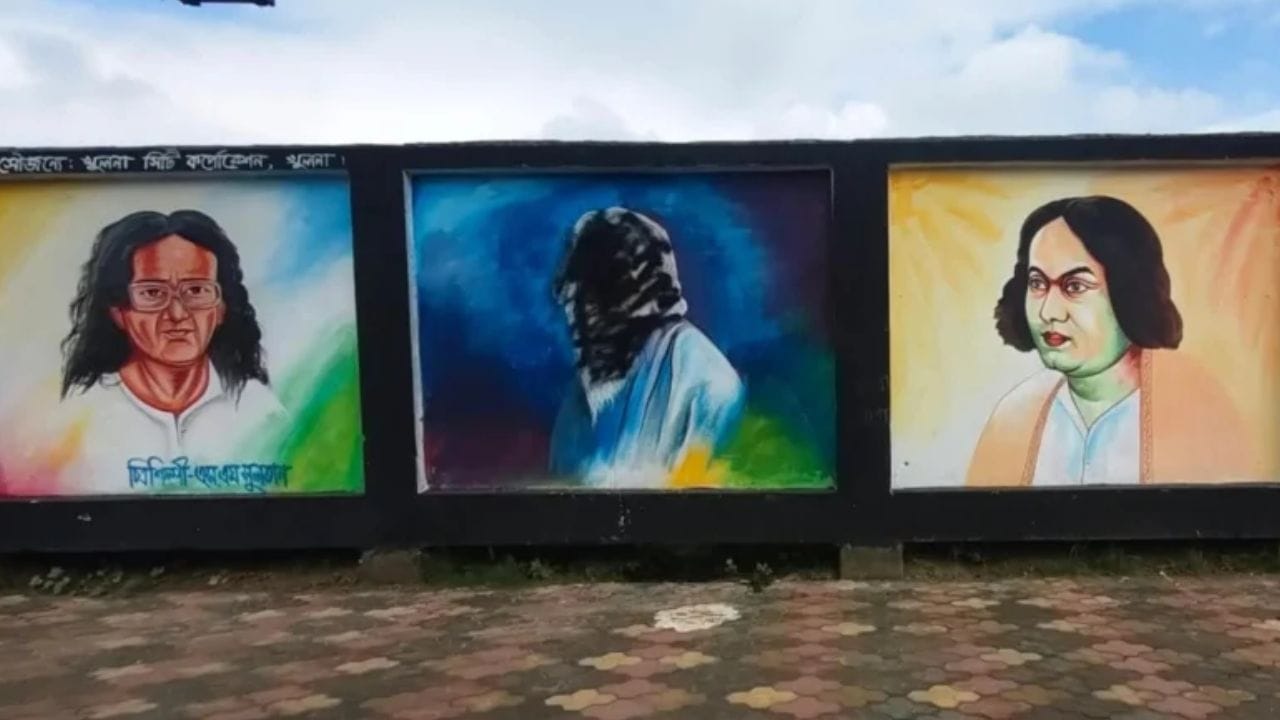
In Khulna, Bangladesh, a mural depicting Rabindranath Tagore on a boundary wall near the Shib Bari Chowrha has been defaced again. The act occurred at a busy crossroads, where a wall near the railway boundary beside the Khulna Development Authority building features Tagore’s face among scenes from July’s uprising and other notable figures. The incident was confirmed after observers found fresh black ink on Tagore’s portrait.
The artwork, created on a public wall under the Open Wall Initiative supported by the Khulna City Corporation, has drawn attention for its cultural significance as well as its location at a busy junction. While other portions of the same wall remained untouched, Tagore’s face was the focal target of the vandalism, according to local sources.
Among the figures depicted alongside Tagore are revolutionary poet Kazi Nazrul Islam, former prime minister Khaleda Zia, former president Ziaur Rahman, poet Michael Madhusudan Datta, and victims of the July uprising, Abu Said and Osman Hadi. Police officials at Khulna Sadar Police Station have said they are aware of the incident and are working to identify those responsible.
The renewed defacement marks the second time in 16 days that the Tagore portrait has been targeted at the same location. The wall is part of a broader display that also includes images of national leaders and prominent figures, making the vandalism a conspicuous cultural and political provocation for residents and visitors alike.
Officials from the Khulna City Corporation’s administration reported that the other portraits and graffiti on the wall had not sustained damage, suggesting the attack focused specifically on Tagore’s image. The incident has raised concerns about protection for public art and for the memory of cultural icons in public spaces.
Earlier, in October, law enforcement recorded a separate incident involving attempts to erase Tagore’s painting at a different site. Police later said they detained four members of a group affiliated with the Bangladesh Shilpa Kala Academy after an effort to remove Tagore’s portrait in front of Seikunbagicha’s wall.
In a related note, local authorities are coordinating with law enforcement to review surveillance footage and canvass nearby areas for clues. The ongoing investigation aims to identify the individuals responsible and determine whether the act was part of a broader pattern of vandalism targeting the same artwork or others in the city.
Observers describe the repeated assaults on the Tagore portrait as troubling for Khulna’s public art scene and for the city’s sense of security at key urban spaces. As police efforts continue, community leaders have urged calm while emphasizing the importance of safeguarding cultural symbols that connect people to the nation’s artistic and historical legacy.