

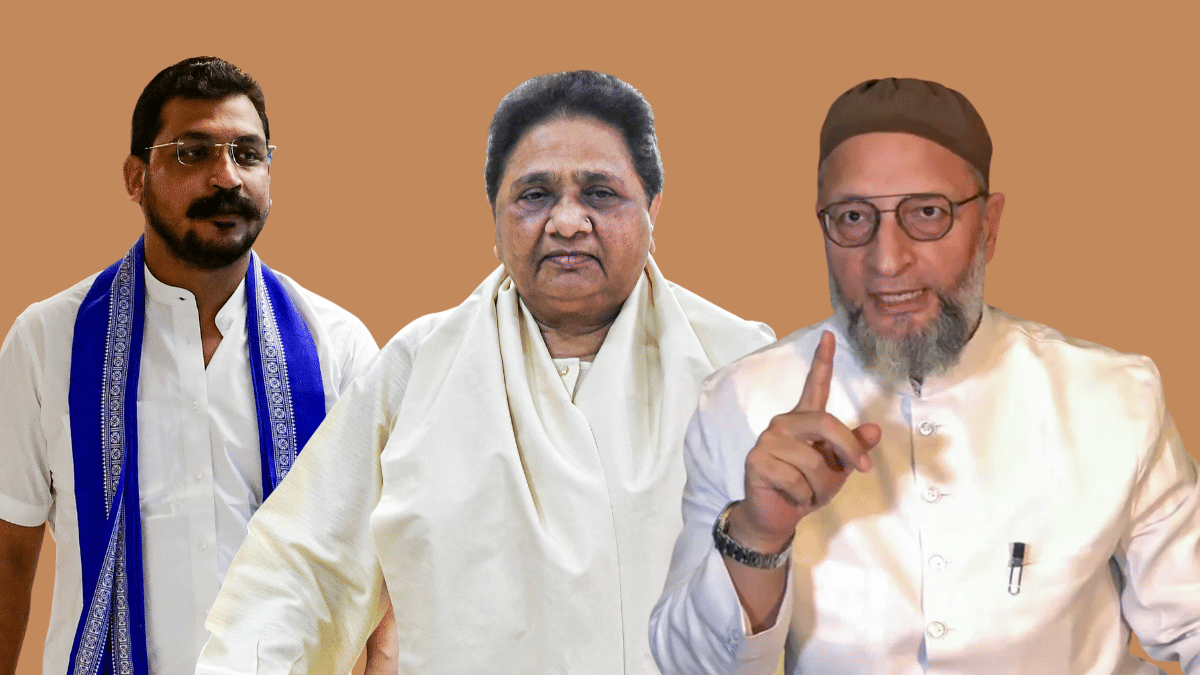
The Samajik Parivartan Morcha alliance between AIMIM chief Asaduddin Owaisi and Azad Samaj Party (Kanshiram) leader Chandrashekhar Azad is expected to cut into anti-incumbency votes in Uttar Pradesh. Analysts cited in the report say it may harm the Samajwadi Party, but poses a bigger threat to Mayawati’s Bahujan Samaj Party, which is already facing an existential crisis in the state.
Why the Owaisi-Chandrashekhar front worries the BSP
The Samajik Parivartan Morcha is expected to draw much of its support from Dalit and Muslim voters. Chandrashekhar Azad, a member of the Jatav community, has emerged as a prominent Dalit leader, while Asaduddin Owaisi’s political support is concentrated largely among Muslims.
Both communities have traditionally been important to the BSP’s social coalition, particularly the Jatav vote. Mayawati has also made repeated attempts to consolidate Muslim support. The alliance could therefore intensify competition for sections of the electorate the BSP has traditionally sought to retain.
Lucknow University Political Science Professor Kaviraj said the decision to project Chandrashekhar as a chief ministerial candidate was premature. He argued that the leader’s priority should be to build a strong organisational cadre across the state.
“Even at its weakest, the BSP has a stronger organisational cadre than the ASP. Mayawati has been a four-time chief minister. However, if this alliance manages to dent even 5,000 Jatav votes in western Uttar Pradesh, it could hurt the BSP more than SP,” he told ThePrint.
He added that making inroads into the Muslim vote bank would be difficult, as the community largely consolidated behind the INDIA bloc in the 2024 Lok Sabha elections.
BSP’s sliding vote share and Chandrashekhar Azad’s rise
The BSP’s declining electoral influence in Uttar Pradesh over the past decade has coincided with Azad’s emergence as a prominent Dalit leader. The 38-year-old first came into the political spotlight during the 2017 Saharanpur caste violence, when he was leading the Bhim Army, an organisation that had emerged as a platform for Dalit empowerment.
The Uttar Pradesh Police booked him under the National Security Act (NSA) — a law that allows detention without trial for up to a year — and he was later released on bail. He gained wider national recognition during the 2020 protests against the Citizenship Amendment Act (CAA). He attempted to organise a march from Delhi’s Jama Masjid to Jantar Mantar without police permission and was subsequently detained by Delhi Police.
Since then, he has built an identity around Dalit rights and social justice, although his political journey has also been marked by controversies and legal cases. His Azad Samaj Party (Kanshiram), founded in March 2022, has gradually expanded across Uttar Pradesh, with units in all 75 districts and district offices in more than 30, most operating from rented premises. Its footprint has also extended beyond its traditional base in western Uttar Pradesh.
The party contested its first election in the 2022 Uttar Pradesh Assembly polls but failed to win a single seat, with all its candidates losing their deposits. Azad himself contested against Chief Minister Yogi Adityanath from Gorakhpur Sadar, securing just 7,640 votes and forfeiting his deposit.
He made a significant electoral comeback in the 2024 Lok Sabha elections, winning the Nagina constituency. Following his victory, Azad announced plans to field candidates in all 403 Assembly constituencies in the 2027 Uttar Pradesh elections. His subsequent decision to join hands with AIMIM has given the proposed third front a wider political footprint.
Political observers believe the BSP’s declining electoral presence has created space for Azad to expand his support among Dalit voters. Once a formidable force in Uttar Pradesh politics, the BSP built its strength through a social engineering formula that brought Dalits, particularly Jatavs, together with sections of upper castes and other communities.
In the 2022 Assembly elections, the BSP won just 1 of the state’s 403 seats, with its vote share falling to 12.9 per cent, its lowest since 1993. It also trailed several smaller parties, including the BJP’s allies Apna Dal (S), the Nishad Party and the Suheldev Bharatiya Samaj Party (SBSP), as well as the Rashtriya Lok Dal (RLD), in terms of seats won.
The party’s performance deteriorated further in the 2024 Lok Sabha elections, when it failed to win a single seat and secured just 9.88 per cent of the total votes polled.
Uttar Pradesh-based political analyst Shilp Shikha Singh said the political vacuum created by the BSP’s decline has helped Azad emerge as a political force, and his rise could make it harder for the BSP to regain lost ground.
“The BSP remains caught up in its internal issues. Mayawati’s repeated decisions to remove her nephew Akash Anand and subsequently reinstate him have also damaged the party’s political narrative. Even if the party makes a serious effort to stage a comeback, it will first have to contend with the challenge posed by Owaisi’s AIMIM. Only after addressing these challenges can it turn its attention to the Samajwadi Party and the Congress,” Singh said.
Mayawati and Azad trade charges
Although Azad has repeatedly sought to position himself as a political alternative to Mayawati, he has largely refrained from directly attacking the BSP chief, often referring to her as “Behen ji” or “Bua ji.” During the 2022 Assembly elections, however, he took a swipe at the BSP, alleging that the party linked merit to money and dynastic politics.
According to ASP sources, Azad is aware that Mayawati remains the tallest leader of the Jatav community, and a direct attack on her could alienate sections of the community whose support he hopes to attract.
Mayawati, too, largely avoided naming Azad directly in her attacks until recently. In September this year, she launched her first direct attack on the Nagina MP and ASP chief.
Mayawati alleged that Azad had no independent support base and that the BJP had helped him win the Nagina Lok Sabha seat in the 2024 elections. She also raised allegations of EVM manipulation, claiming the BJP had tampered with the machines in Nagina to ensure Azad’s victory, and accused him of working at the BJP’s behest.
The BSP chief further questioned Azad’s reliance on protests and political movements, alleging that instead of helping victims secure justice, he encouraged them to stage sit-ins and demonstrations, often leaving young people facing criminal cases. Mayawati appealed to members of the Dalit community not to be misled by the Nagina MP.
AIMIM’s Uttar Pradesh footprint and SP’s worries
Owaisi’s AIMIM has also attracted attention in Uttar Pradesh despite its limited overall electoral presence. In the 2022 Assembly elections, the party fielded candidates in 95 constituencies but failed to win a single seat. It secured 4,50,929 votes, accounting for approximately 0.49 per cent of the total votes polled, and all 95 candidates forfeited their deposits.
However, in several constituencies, AIMIM candidates polled more votes than the winning margins of candidates from other parties, particularly the SP. In Sultanpur, the SP lost to the BJP by just 1,009 votes, while the AIMIM candidate secured 5,251 votes. In Kannauj, the SP’s defeat margin was 6,090 votes, compared with the 4,482 votes polled by AIMIM.
The gap was even narrower in Ramnagar in Barabanki, where the SP lost by 261 votes while AIMIM secured 4,940 votes. In Aurai, the SP lost by 1,647 votes, against the 2,190 votes secured by AIMIM. In Shahganj, where the SP lost to the Nishad Party by 719 votes, AIMIM polled 8,128 votes.
These figures are often cited in discussions about AIMIM’s potential impact on the SP’s electoral prospects. However, the report notes it would be incorrect to assume that all votes polled by AIMIM candidates would automatically have gone to the SP in their absence.
Questions readers are asking
What is the Samajik Parivartan Morcha? It is the alliance between Asaduddin Owaisi’s AIMIM and Chandrashekhar Azad’s Azad Samaj Party (Kanshiram), formed ahead of the 2027 Uttar Pradesh elections, in which Azad has said the ASP will field candidates in all 403 seats.
Why could the alliance hurt the BSP more than the SP? Professor Kaviraj said that if the alliance manages to dent even 5,000 Jatav votes in western Uttar Pradesh, it could hurt the BSP more than the SP, because Dalit and Muslim voters have traditionally been part of the BSP’s social coalition.