

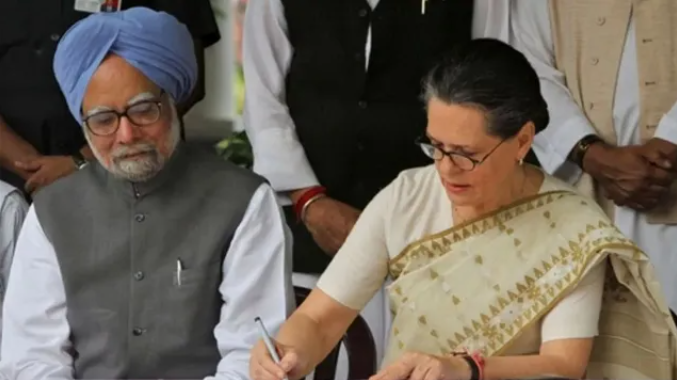
New Delhi, Delhi: Former Prime Minister Manmohan Singh has received significant relief in the coal block allocation case following a Supreme Court decision, prompting the Congress to once again highlight his record of integrity and accountability in public life.
The court’s decision has also brought renewed attention to Singh’s own prediction that history would judge his tenure more fairly than his political opponents and sections of the media had done at the time.
Sonia Gandhi Praises Manmohan Singh’s Record
Congress leader Sonia Gandhi, speaking on Tuesday, praised Singh’s record in public life and highlighted what she described as his commitment to honesty and accountability.
She also criticised the functioning of the Narendra Modi government, drawing a political comparison between the two administrations.
Her remarks came after the Supreme Court’s July 29 decision, which has once again brought the long-running coal block allocation controversy into the political spotlight.
Manmohan Singh’s 2014 Remark Resurfaces
The latest development has also revived interest in a statement made by Singh during his final press conference as Prime Minister in January 2014.
At the time, Singh expressed confidence that history would ultimately judge his record more favourably than the criticism he had received from political opponents and sections of the media.
His comments came when the UPA government was facing intense political pressure over allegations of corruption and questions surrounding several major policy decisions.
The coal block allocation controversy was among the issues that became a significant political challenge for the government.
What Was the Coal Block Controversy?
The allocation of coal blocks came under scrutiny over concerns about the process used to distribute the country’s coal reserves.
Opposition parties repeatedly questioned the government’s decision-making and transparency.
Singh also became a focus of political criticism because of his association with the Coal Ministry and decisions taken during the period.
The controversy remained a major issue during the latter part of the UPA government’s second term, with questions being raised about the role of government authorities, allocation procedures and the responsibility of senior officials and political leaders.
Congress Calls the Court Decision a Vindication
Following the Supreme Court’s July 29 decision, Congress leaders have presented the development as an important vindication of Manmohan Singh’s personal integrity.
The party has also used the occasion to revisit Singh’s 2014 remarks and argue that his personal reputation should be considered separately from the controversies that surrounded his government.
For Congress, the development provides an opportunity to reinforce its long-standing portrayal of Singh as a leader known for his personal honesty and understated style of governance.
Sonia Gandhi Adds Political Dimension
Sonia Gandhi’s comments have added a fresh political dimension to the issue.
While praising Singh, she criticised the Modi government’s functioning and sought to draw a distinction between the two administrations on matters of accountability, transparency and public conduct.
The remarks are likely to keep the issue within the broader political debate over the contrasting records of previous and current governments.
Manmohan Singh’s Political Legacy
Manmohan Singh served as India’s Prime Minister from 2004 to 2014.
An economist by profession, he held several important positions in public life, including Finance Minister, and played a major role in India’s economic reforms during the early 1990s.
His first term as Prime Minister was associated with strong economic growth and several social welfare initiatives.
His second term, however, faced a series of corruption allegations, policy controversies and growing political opposition, which eventually became major issues in the 2014 general election.
History’s Verdict Remains a Political Debate
The latest Supreme Court development has once again placed Manmohan Singh’s legacy at the centre of political discussion.
For the Congress, the court decision and Sonia Gandhi’s remarks offer an opportunity to revisit Singh’s belief that history would eventually provide a more balanced assessment of his record.
The political debate over his tenure is likely to continue, with supporters pointing to his personal integrity and economic legacy, while critics continue to focus on the controversies that affected the UPA government.
More than a decade after Manmohan Singh left office, his record continues to remain an important part of India’s political debate—and his prediction that history would ultimately judge him remains central to the discussion.