

New Delhi, Delhi
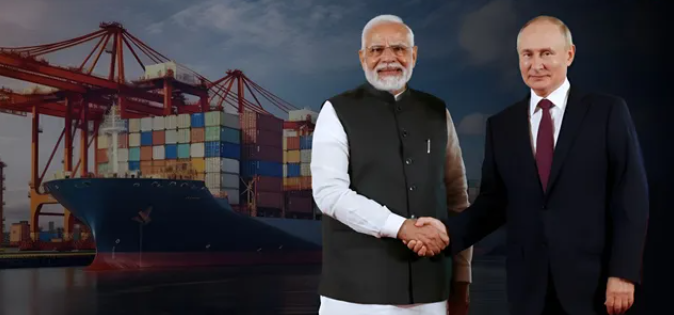
After cooperation in energy, defence and strategic affairs, maritime connectivity is now emerging as an important area in India-Russia relations. India is preparing to send its first cargo to Europe through the Northern Sea Route (NSR), with the first shipment reportedly planned for 2027.
The Northern Sea Route runs along Russia’s northern coastline through the Arctic Ocean. It could serve as an alternative to traditional maritime routes connecting Europe and Asia. One of its key advantages is that it can offer shorter distances on certain routes. According to available estimates, transit times on some journeys could potentially be reduced by up to 40%.
India’s initiative is not being viewed purely from a commercial perspective. Disruptions affecting major global trade routes, including the Red Sea and Suez Canal, have increased the need for alternative trade corridors. In this context, the Arctic route could provide India with an additional option for maritime logistics.
India and Russia Strengthen Cooperation on the NSR
Discussions between India and Russia on the Northern Sea Route are now progressing within a formal framework. The two countries have established a Joint Working Group for cooperation on the NSR.
Its first meeting was held in New Delhi on October 10, 2024. During the meeting, Indian and Russian representatives discussed cargo transit through the NSR, Arctic shipbuilding and polar navigation training for Indian seafarers.
India is also exploring opportunities for economic cooperation with Arkhangelsk, a major Russian Arctic region. Potential areas of cooperation include port utilisation, shipbuilding and cargo transportation.
Clarifying the 40-Day and 24-Day Figures
There is an important distinction regarding the figures of 40 days and 24 days. The reduction from 40 days to 24 days is not directly related to the Northern Sea Route.
According to the Indian government, the Eastern Maritime Corridor between Chennai and Vladivostok could reduce cargo transit time between India and Russia’s Far Eastern ports from around 40 days to approximately 24 days.
By contrast, the actual transit time for cargo from India to Europe through the Northern Sea Route will depend on several factors, including the destination, weather conditions, vessel capacity and Arctic operating conditions. Therefore, it would be premature to specify a fixed number of days for India’s first NSR cargo shipment.
Arctic Route Faces Several Challenges
The Northern Sea Route also presents significant challenges. Sea ice, extreme cold, the requirement for specialised ice-class vessels, icebreaker support, insurance costs and limited port infrastructure can all affect the cost and reliability of the route.
Despite these challenges, India’s growing interest in the NSR indicates that New Delhi is exploring alternative maritime corridors alongside traditional trade routes.
If the initiative succeeds, it could strengthen India-Russia maritime cooperation while also increasing the strategic importance of the Arctic route in Europe-Asia trade.