

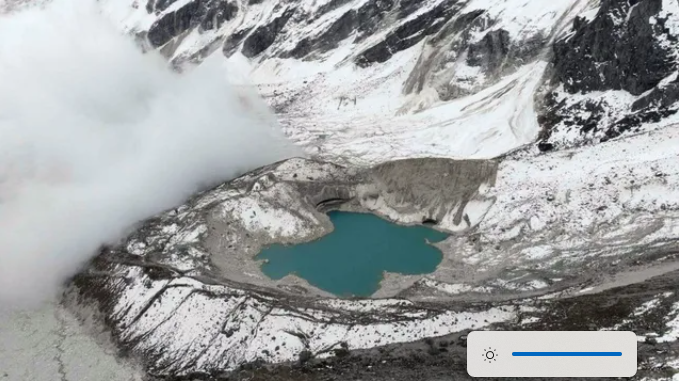
New Delhi, Delhi: Following the sudden flood caused by a glacial lake outburst in Nepal, India has stepped up its vigilance over vulnerable glacial lakes across the Himalayan region. The incident has once again highlighted the dangers posed by Glacial Lake Outburst Floods (GLOFs), which can cause widespread destruction not only in mountainous states but also in downstream areas.
According to government and scientific assessments, the Himalayan region is home to around 7,500 glacial lakes. Of these, nearly 200 lakes have been identified as potentially hazardous. In Sikkim alone, around 25 lakes are classified as highly vulnerable. Thousands of glacial lakes are also located in the Ganga river basin, further increasing the risk of disasters in these regions.
Experts say that the edges of glacial lakes are often held back by natural dams made of ice, rocks and debris. Heavy rainfall, avalanches, landslides or rockfalls can weaken these natural barriers. If such a dam collapses, a massive volume of water and debris can suddenly rush downstream, triggering devastating floods within a short period of time.
India witnessed a major disaster in October 2023 linked to the South Lhonak Lake in Sikkim. The incident highlighted the urgent need for continuous monitoring of glacial lakes and effective early-warning systems across the Himalayan region. The sudden flooding caused extensive damage in several areas.
Following the recent incident in Nepal, experts have warned that disasters in the Himalayan region can often occur as a chain reaction. A collapse of ice or rocks at higher altitudes can lead to the accumulation of debris, block a river and create a temporary lake. When such an obstruction eventually breaks, sudden floods can rapidly reach downstream areas.
Under India’s National GLOF Risk Reduction Programme, around 195 potentially hazardous lakes have been identified. The programme focuses on risk assessment, regular monitoring, early-warning systems, risk mitigation measures and increasing awareness among local communities.
After the Sikkim disaster, the central government formed a high-level coordination committee chaired by the Principal Secretary to the Prime Minister. Several agencies, including the National Disaster Management Authority (NDMA), Central Water Commission, Geological Survey of India, C-DAC, ITBP and the Indian Army, are involved in studying and monitoring vulnerable glacial lakes.
The recent disaster in Nepal has served as a warning for India. Experts believe that scientific monitoring of the Himalayan region and stronger early-warning systems will be among the most effective ways to reduce the risks posed by such disasters in the future.