

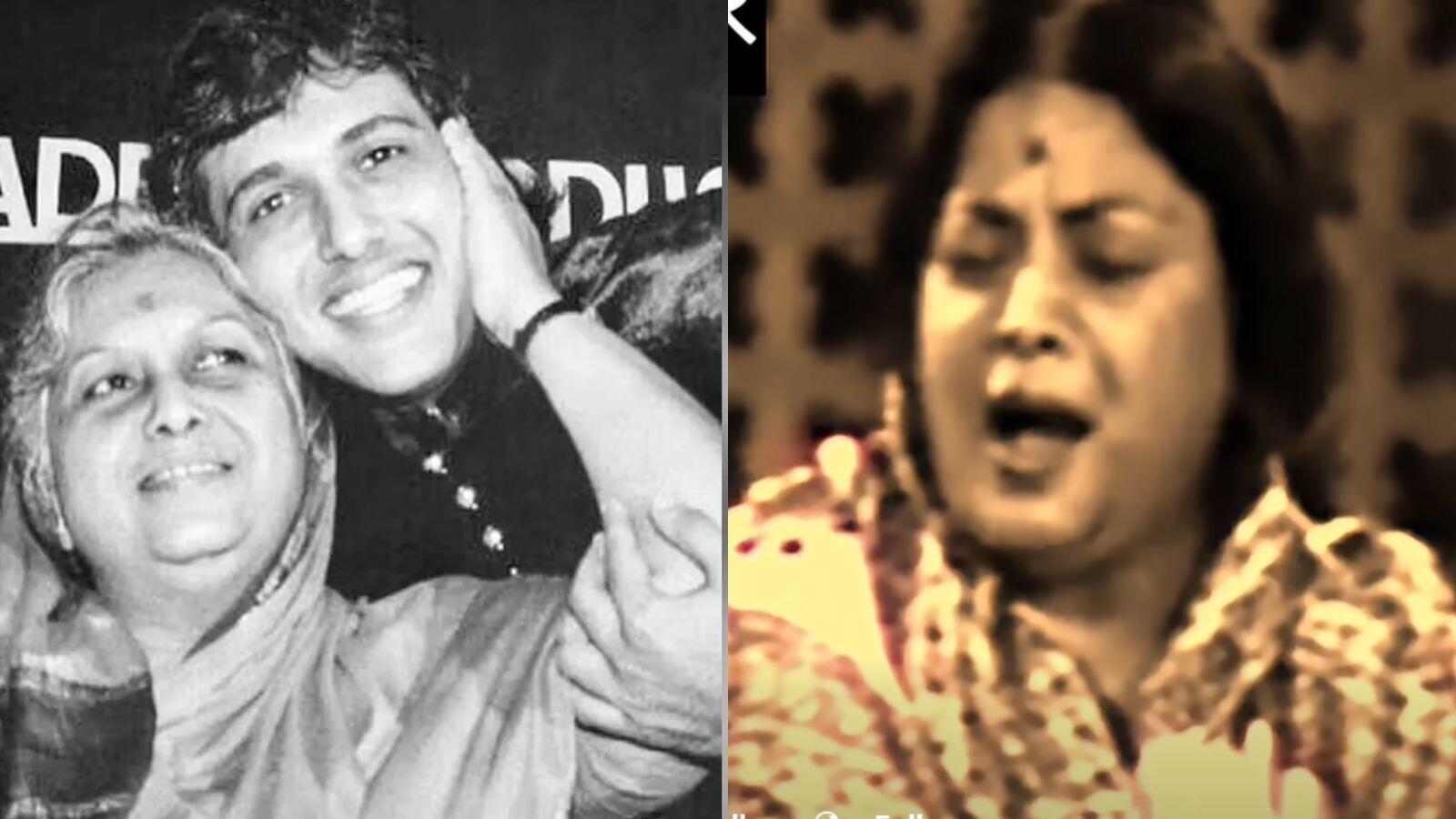
In a revealing look at Govinda’s family history, it emerges that his mother, Nirmala Devi, was not only a recognized actress and singer in Hindi cinema but also left the industry within a decade of starting her career. She shaved her head and devoted herself to raising her five children, choosing a path of renunciation over the glamorous life she once pursued. Govinda has often spoken of how his upbringing reflects the influence of a mother who embraced vairagya, or detachment from worldly pleasures.
Beyond her acting and singing, Nirmala Devi was known for performing ghazals with emotional depth. A ghazal she recorded, written by Behazad Lakhnavi, captures her singing in a way that fans and collectors recall. The piece is closely associated with Begham Akhtar’s repertoire, and Devi is credited with conveying classical ghazals with sensitivity in archival and classic recordings.
Nirmala Devi’s Gajal and Her Sacrifices
In a conversation with ABP Live, Govinda recalled a pivotal moment from his childhood when his mother’s career had a sudden impact on the family. He described a period when they were so destitute that the entire household goods were taken away, leaving the family in distress. His father reportedly warned Nirmala that her beauty should not lead to further public scrutiny, prompting her to shave her head and become a devotee, vowing to let her children grow up in peace and security.
Govinda has often described the enduring influence of a mother who abandoned her Bollywood ambitions to become a sanyasin. He states that this experience shaped his own worldview and contributed to his determination to achieve success in the film industry. Speaking about his status as a son of a mother who faced hardship, he said that he does not care about what others say about him, focusing instead on his mother’s path and their family’s resilience.
Historically, Nirmala Devi began her film career in 1942 as a leading actress in V. C. Desai’s film Savera. She acted in several other projects, including songs for S. U. Soni’s Geet, Ramaa Chaudhary’s Gali (1944), Nanabhai Bhatt’s Chalis Crores (1946), and M. Sadik’s Anmol Ratan (1950). In 1942, she reportedly ran away from home with her co-star Arun Kumar Ahuja, a move that foreshadowed the unconventional life she would lead.
Later, in 1948, Nirmala Devi and Arun Kumar Ahuja collaborated again on the home-produced film Sehra, which did not perform well at the box office. After her last film, Jay Mahalaksmi (1951), she stepped away from cinema and dedicated herself to raising her five children—three daughters and two sons—fully into domestic life and spiritual pursuits. This transition marked a defining shift from public star to private mentor for Govinda and his siblings.
The family faced further upheaval when the Sehra project flopped, prompting Govinda’s parents to vacate their Mumbai bungalow on Carter Road and relocate to the suburb of Virar. Childhood memories of his mother’s perseverance during those hard times inspired Govinda to pursue acting with renewed vigor. In a 2003 appearance on Rendevu with Simi Garewal, he recalled watching his mother struggle through life’s harshest moments and vowed to change their circumstances as soon as possible.