

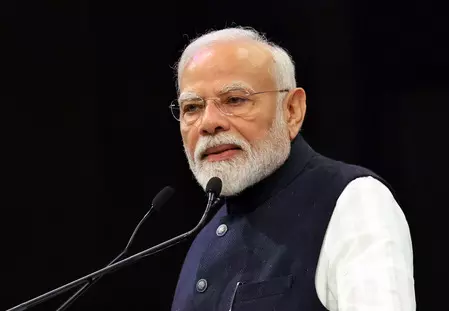
Prime Minister Narendra Modi on Thursday addressed the ‘Kisan Tak Bharat Agriculture Conference 2026’ in New Delhi, where scientists, agri-entrepreneurs and farmers from across the country gathered. He praised the group’s enthusiastic participation in the cleanliness drive and for dedicating two full days to organising this unique ‘Kisan Mela’.
Agriculture as the base of Indian culture
Modi noted that the conference is being held just days after Diwali and during the Chhath festival, which is deeply connected to agricultural life. He said major Indian festivals such as Bihu, Pongal, Onam, Baisakhi, Sarhul and Pola are also closely linked to farming. “This means that agriculture and farming are the foundation of our culture, our tradition and our social life,” he said.
Recalling his Red Fort speech on the seven pillars (Saptadhara) needed for a ‘Vikasit Bharat’, the Prime Minister said agriculture is a key pillar among them. He stressed that farmers’ conferences have become more important because the country’s development directly depends on modernising agriculture. “Without developing agriculture, making farming smart and empowering farmers, building a ‘Vikasit Bharat’ is not possible,” Modi said.
He cited a World Bank study report to highlight the link between farm growth and national progress. According to the report, 50 crore Indians came out of poverty in just 12 to 13 years, with a sharp decline in rural poverty among small farmers and farm labourers. Modi said that during this period, India’s agriculture sector achieved an average growth rate of more than 4 percent in the first decade after independence.
The Prime Minister said farmers and agriculture experts understand that continuous changes in policies and practices are necessary. He noted that as global markets, eating habits, weather patterns and technologies have changed, farmers need to be empowered afresh. Merely filling granaries is not enough, he added.
Modi mentioned steps taken in the last decade to keep pace with global agricultural changes and boost farmers’ incomes through annual farm exports of more than Rs 4 lakh crore. He said India now ranks first in the world in the production of milk, pulses, jute, rice and millets, while it is second in wheat, cotton, fruits, vegetables and fish. “These are not just some figures, but they show how much the capability of India’s farmers has increased,” he said.
Focus on crop diversification and new revolutions
Emphasising the need to move beyond the traditional dependence on wheat, rice and sugarcane for farmers’ prosperity, the Prime Minister said the government is actively promoting crop diversification and other agriculture-related activities. He detailed India’s journey from becoming self-reliant in foodgrains through the Green Revolution to becoming the world’s largest milk producer through the White Revolution.
Modi spoke about the rapid expansion in several sectors in the past decade: milk production up by nearly 70 percent, egg production up by about 90 percent, fish production more than doubled under the Blue Revolution, honey production rising from about 80,000 tonnes to 1.5 lakh tonnes under the Sweet Revolution, and horticulture production increasing from 280 million tonnes to more than 350 million tonnes. “The figures I have placed before you today show that this journey is now moving forward in a very splendid manner,” he said.
He said linking these various agricultural revolutions under a broad approach creates multiple sources of income, which is essential for future farming. He made special mention of the ‘solar energy revolution’ under the PM KUSUM scheme, through which about 12 lakh solar pumps have been provided. This has not only reduced electricity bills but also allowed farmers to generate solar energy on their farms and earn extra income. “This revolution has turned the nation’s ‘Annadata’ into ‘Urjadata’. We have focused not only on production in farming but also on productivity and farmers’ profits,” Modi said.
Recalling his 25 years in government, including as Gujarat chief minister when he promoted ‘Krishi Mahotsavs’ to modernise farming, the Prime Minister said hundreds of agriculture scientists and experts went to villages in scorching heat of 40 to 45 degrees. They tested soil, assessed water availability and advised farmers on the right crops and farming methods. “We moved with the concept of ‘lab to land’ so that the knowledge in scientists’ laboratories could reach farmers’ fields directly. This greatly benefited Gujarat’s farmers,” he said.
Technology, FPOs and support for farmers
Modi said his Gujarat experience proved useful at the national level. He noted that soil testing laboratories in India, which numbered a few hundred in 2014, have now increased to more than 8,400. Over 725 Krishi Vigyan Kendras are also working. Animal health has been prioritised through a large vaccination drive against foot-and-mouth disease. “To protect animals from this disease, more than 8 crore farmers’ animals have been given free vaccines,” Modi said.
Countering the old belief that rural India cannot adopt modern technology, the Prime Minister gave the example of ‘Namo Drone Didi’. He said these women have efficiently operated drones to spray fertilisers and pesticides, proving wrong those who doubted it. “Now the scope of its use is also being expanded,” Modi said.
He stressed the growing role of engineering in Indian agriculture, noting that scientists, engineers and youth are developing machines that reduce the cost of sowing and harvesting. Affordable devices equipped with sensors and artificial intelligence are also being created to provide accurate data even to small farmers. The Prime Minister emphasised value addition at the farm level and turning ‘Annadata’ into ‘agri-entrepreneurs’ through a strong ecosystem of agri-engineering and agri-startups.
“In recent years, small farmers, together with the government, have prepared a large network of 10,000 FPOs (Farmer Producer Organisations). This network is making groups of small farmers ‘value creators’ and connecting them with food processing and export markets,” Modi said. He emphasised that the government’s clear policy and intention is that farming should not become a burden on farmers.
He said that in the last 12 years, India has spent Rs 16 lakh crore to provide affordable fertiliser to farmers. This was done when international fertiliser prices had risen significantly due to the ongoing war in Iran and the Gulf region. “A bag of DAP, which costs Rs 5,000, is being given to Indian farmers for Rs 1,300. Similarly, a bag of urea, which costs Rs 3,000 in the international market, is being given to farmers for less than Rs 300,” Modi said.
Sharing a special detail, the Prime Minister said the government protected farmers when crude oil prices rose from $70 to $122 per barrel in a few weeks due to the escalating war in West Asia. At that time, there was pressure to increase diesel prices by at least Rs 50 per litre, while neighbouring countries raised fuel rates by 40 to 50 percent. He said the government did not let the burden of this international shock fall on citizens and farmers. It raised diesel prices by only Rs 7 per litre and bore the burden of Rs 43 per litre itself. This has cost the government Rs 14,000 crore every month. “Such sensitive decisions are taken only when the interest of the country’s farmers is paramount and there is a feeling of ‘Nagarik Devobhav’,” Modi said.
At the end of his address, the Prime Minister appreciated the major achievements of Indian farmers in recent years. He called for more efforts to build a ‘Vikasit Bharat’ where farmers are prosperous, villages are happy and agriculture is modern and profitable. He expressed confidence that the discussions at the conference will benefit the country and extended his best wishes to all. He said the government will also work on the better suggestions and solutions that have emerged here.