

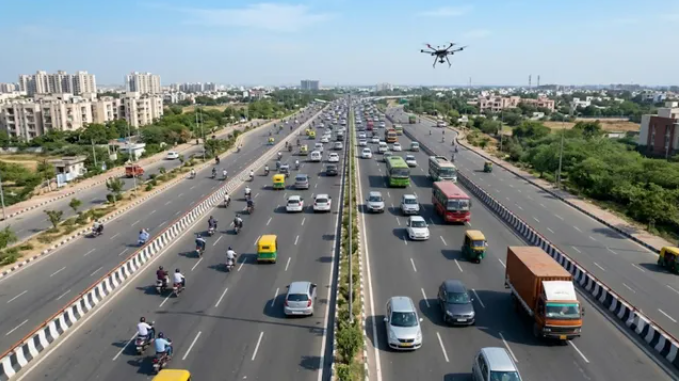
Traffic congestion has become a major challenge in metropolitan cities and on busy highways across the country. During morning and evening peak hours, the number of vehicles on roads increases significantly. Traffic movement is often disrupted by accidents, narrow roads, and excessive vehicle density. In such situations, identifying the exact causes of congestion and taking appropriate management measures becomes essential.
Data Collected from a Highway Near Delhi
To develop the model, IIT Guwahati researchers used a highway located near Delhi. High-resolution traffic data was collected using drones. Based on this information, researchers studied vehicle movements and traffic patterns on the road.
Drones make it possible to monitor large sections of a road simultaneously. Instead of observing traffic conditions at a single location, this approach can provide a broader understanding of vehicle movement across an entire area.
AI Technology to Analyze Traffic Patterns
Artificial Intelligence plays a crucial role in this model. AI technology can analyze the data collected through drones and help identify vehicle speeds, traffic volumes, and increasing pressure on roads.
This technology can help determine the conditions under which traffic flows smoothly and when congestion begins to develop. Such insights can support better decision-making by traffic management authorities.
An Important Initiative for India’s Traffic Management System
Road traffic conditions in India are significantly different from those in many other countries. Cars, buses, trucks, auto-rickshaws, and two-wheelers often share the same roads. Therefore, technologies developed according to local traffic conditions may prove more effective than models designed for foreign road systems.
IIT Guwahati’s initiative is considered an important step toward developing an efficient traffic management system specifically suited to Indian roads.
In the future, this model could be used in cities and on highways to monitor traffic conditions, identify congestion-prone areas, and develop better road management strategies. However, further testing and evaluation will be necessary to establish its effectiveness and suitability for large-scale implementation.