

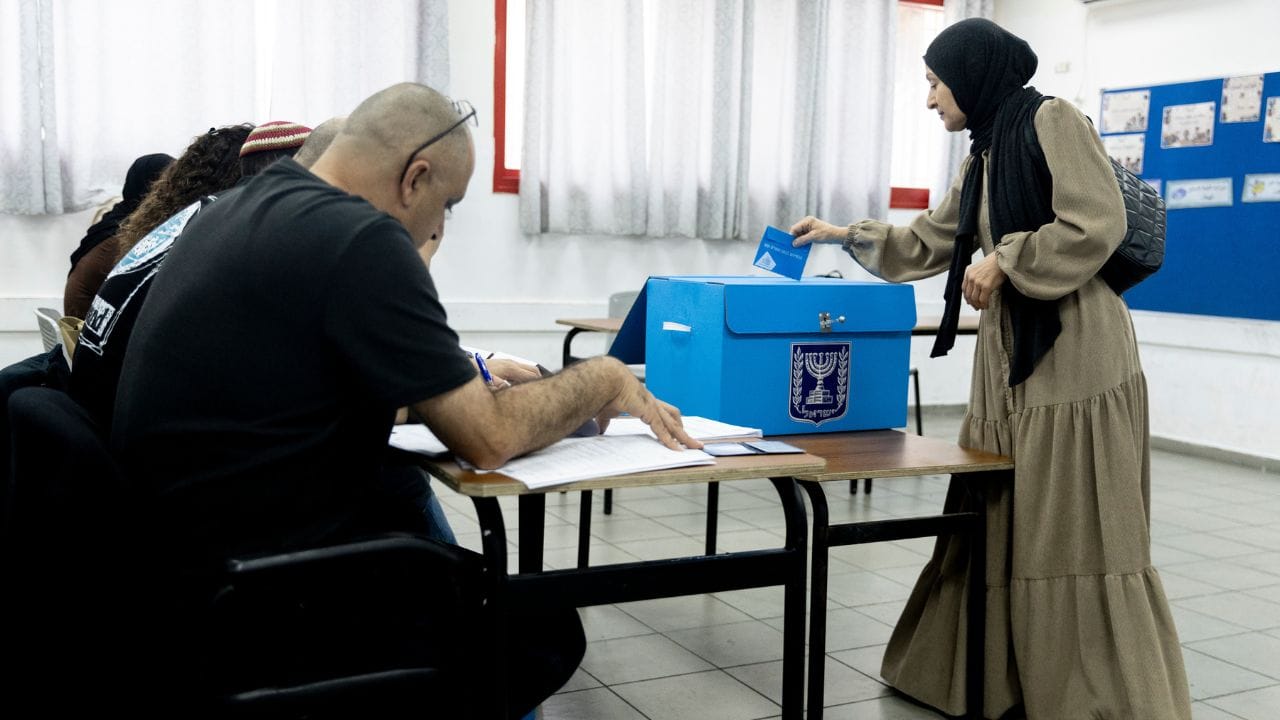
Israel’s recent parliamentary election, held on 27 October, brought intense competition between Prime Minister Benjamin Netanyahu’s coalition and the opposition. Early projections suggest that Arab parties could play a decisive role by securing up to 19 seats in the Knesset. These estimates have raised interest as the final results are yet to be confirmed.
Election Results So Far
Exit polls after the election indicate a close race with no clear majority for either Netanyahu’s Likud-led bloc or the opposition alliance led by Gadi Eizenkot. Netanyahu’s coalition is estimated to have 57 seats, while Eizenkot’s coalition is projected to win 47 seats. Both are short of the 61 seats needed to form a government, suggesting that support from other parties will be crucial.
Counting of votes is ongoing, with approximately 41.9 percent of ballots tallied so far, maintaining an uncertain political picture. In this context, the Arab parties’ performance has drawn significant attention because of their potential influence in coalition talks.
Arab Parties’ Growing Influence
The Arab political community in Israel mainly consists of the Joint List and the United Arab List, also known as the Ra’am party. According to a report by Al Jazeera on 28 October, more than 9 percent of votes had gone to the Joint List after counting one-third of total votes. If final counts confirm they win 19 seats combined, this would mark a solid increase in their parliamentary presence.
Arab parties represent a diverse population of Israeli citizens, including Muslims, Christians, and other groups of Palestinian descent. Their platforms focus on civil rights issues such as equality, access to government services, and combating discrimination. This election saw an historic voter turnout in the Arab community, estimated around 80 percent, the highest since 1999.
The potential role of Arab parties in govt formation depends on whether the Jewish opposition will include them in a coalition or provide outside support. This remains uncertain as political negotiations continue. Analysts suggest that their seats could be pivotal in breaking the current deadlock between Netanyahu’s bloc and the opposition.
Voter engagement from the Arab community was a key trend in this election, highlighting their growing political participation and influence. The high turnout signals increased willingness among Arab citizens to shape Israel’s political landscape amid longstanding social and economic challenges.
Despite the rising seat count projections for Arab parties, the final official results are awaited. Until then, Israel faces a complex coalition-building process, with neither leading block holding enough seats to govern alone.
This election’s outcome underscores the importance of smaller parties, especially the Arab factions, in shaping Israel’s next government. Their larger representation may help address long-standing issues affecting Arab Israelis while influencing broader national policies.