

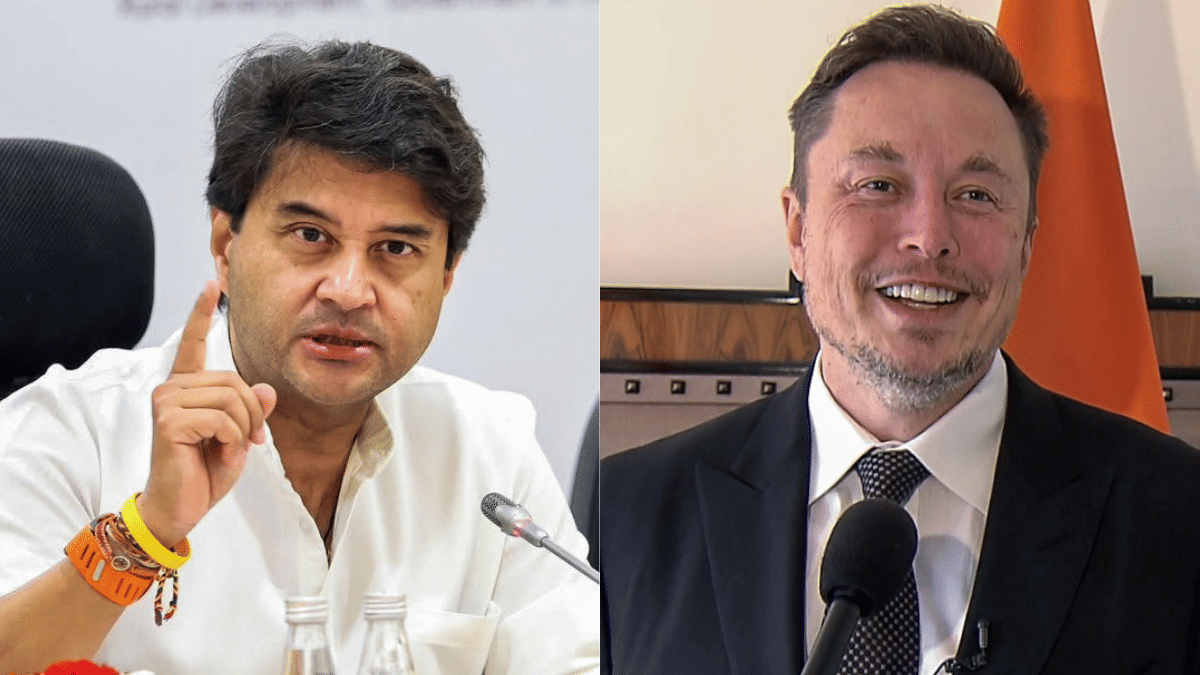
Union Communications Minister Jyotiraditya Scindia addressed Elon Musk’s accusations regarding India’s satellite internet market, firmly denying claims of monopoly and explaining the current status of Starlink’s operations in the country.
Elon Musk’s Allegations on Starlink
SpaceX CEO Elon Musk accused “certain oligarchs” of blocking Starlink’s satellite internet service entry into India. His remarks began with a tweet about over 11,000 Indian villages lacking 4G coverage, followed by insinuations that Mukesh Ambani might be influencing India’s licensing processes. Musk noted Starlink is licensed in more than 165 countries but had yet to receive a license in India.
Government Response and Licensing Status
Jyotiraditya Scindia clarified that three companies, including Starlink, Reliance Jio’s satellite division, and Bharti-backed Eutelsat OneWeb, hold satellite communication licenses. None have yet gained security clearance. Operations will only start once government spectrum charges are finalized and security requirements are met.
Minister of State for Communications Chandra Sekhar Pemmasani added that licenses and provisional spectrum allocations have been issued, but security clearances remain pending with the Ministry of Home Affairs. He stressed that delays do not target any single company.
Political Reactions
Scindia criticized the Congress party for supporting Musk’s statements, suggesting they are inconsistent in their stance. Rahul Gandhi responded to Musk’s tweets, hinting at complexities beyond the Ambani reference.
Market and Regulatory Details
Scindia emphasized that the government is neutral and technology-agnostic, allowing customers to freely choose providers. He also mentioned that Amazon’s Kuiper satellite service must complete licensing before operating.
At the India Mobile Congress, Starlink’s vice-president Lauren Dreyer said the company has set up 20 gateway sites in India and plans to store user data domestically, expressing readiness to serve once approvals are granted.
Approvals and Spectrum Charges
Starlink holds a Global Mobile Personal Communication by Satellite license from the Department of Telecommunications and authorization from the Indian National Space Promotion and Authorisation Centre. However, it needs spectrum allocation, security clearance, and foreign direct investment approval to start commercial services.
The Digital Communications Commission recently approved spectrum usage charges, but the final decision awaits ratification and Cabinet approval.
Spectrum Disputes and Industry Positions
In 2024, Reliance Jio and Bharti Airtel argued for auctioning satellite spectrum, similar to mobile spectrum, while Starlink favored administrative allocation. The government ultimately chose administrative allocation as per the Telecommunications Act, 2023.
In 2025, Airtel and Jio signed agreements to distribute Starlink equipment, contingent on necessary approvals. The Congress party alleged these deals were politically motivated, which has been part of the broader controversy around Starlink’s launch in India.

