

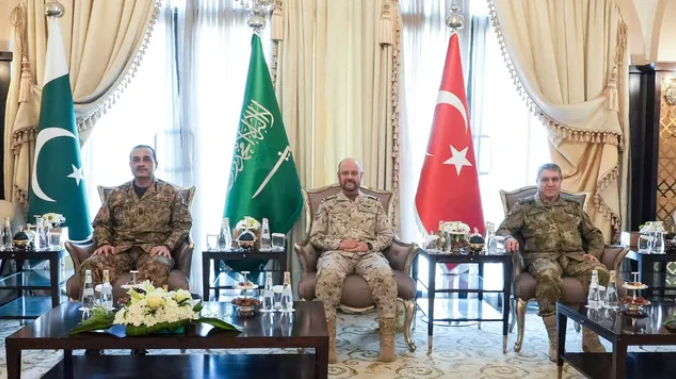
Riyadh, Saudi Arabia
Questions are being raised over Pakistan’s role amid missile and drone attacks by Houthi rebels targeting southern parts of Saudi Arabia. The issue has gained significance because Saudi Arabia and Pakistan recently signed a joint defence agreement, which was presented as an important framework for the collective security of the two countries.
Under the agreement signed in Mecca, an armed attack against one party is considered an attack against all parties. Therefore, the absence of any announcement of direct military action by Pakistan amid continued attacks on Saudi Arabia has intensified debate over the effectiveness of the agreement.
Continued Missile and Drone Attacks on Saudi Arabia
Reports of Houthi rebels targeting areas such as Abha, Khamis Mushait, Jizan and Najran in Saudi Arabia have emerged on several occasions. The drone and missile attacks have required Saudi Arabia to keep its air defence systems on continuous alert.
Amid these developments, concerns have also emerged over security alerts in and around Mecca. This has naturally raised questions about Pakistan’s potential military role.
Claims of a NATO-Style Collective Security Arrangement
The Mecca Joint Defence Agreement was presented as a collective security arrangement between the three countries. Its core principle is that if one member faces an armed attack, the other members will cooperate in its defence.
This has led experts to question why the practical application of the collective defence arrangement has not been clearly visible despite continued attacks on Saudi Arabia.
However, it is important to note that the inclusion of a collective-defence provision in an agreement does not necessarily mean that foreign troops must immediately be deployed into combat after every attack. The nature and extent of any response depend on the decisions of the countries involved and the prevailing military circumstances.
Pakistani Military Presence in Saudi Arabia
Saudi Arabia and Pakistan have maintained defence cooperation for decades. Pakistani military personnel have been present in Saudi Arabia, while the two countries have also maintained longstanding cooperation in military training and security.
Therefore, discussions about the possible use of Pakistan’s military capabilities amid Houthi attacks are not surprising. However, based on the available information, it would be premature to conclude that Pakistan has violated any obligation under the defence agreement.
Is the Response Limited to Meetings and Statements?
On September 25, senior Turkish and Pakistani military officials held discussions in Riyadh on security cooperation. During the talks, their commitment to protecting Saudi Arabia’s sovereignty, security and territorial integrity was reiterated.
However, there was no accompanying announcement of an immediate military operation or direct intervention. This has led critics to question whether the Mecca defence agreement is, for now, limited primarily to strategic signalling and military cooperation.
At the same time, Saudi Arabia’s air defence systems have responded to Houthi attacks. It is therefore also possible that Riyadh currently prefers to address the threat through its existing defence capabilities.
The Real Test of the Agreement May Come Later
The real test of the Mecca Joint Defence Agreement will come if a member state faces a large-scale and direct military threat. The current situation, however, highlights the potential gap between announcing a defence agreement and its actual military implementation.
If Houthi attacks on Saudi Arabia continue, attention on Pakistan’s role is likely to increase in the coming days. For now, Islamabad has reiterated its commitment to supporting Saudi security, but it has not publicly announced any major direct military intervention.

