

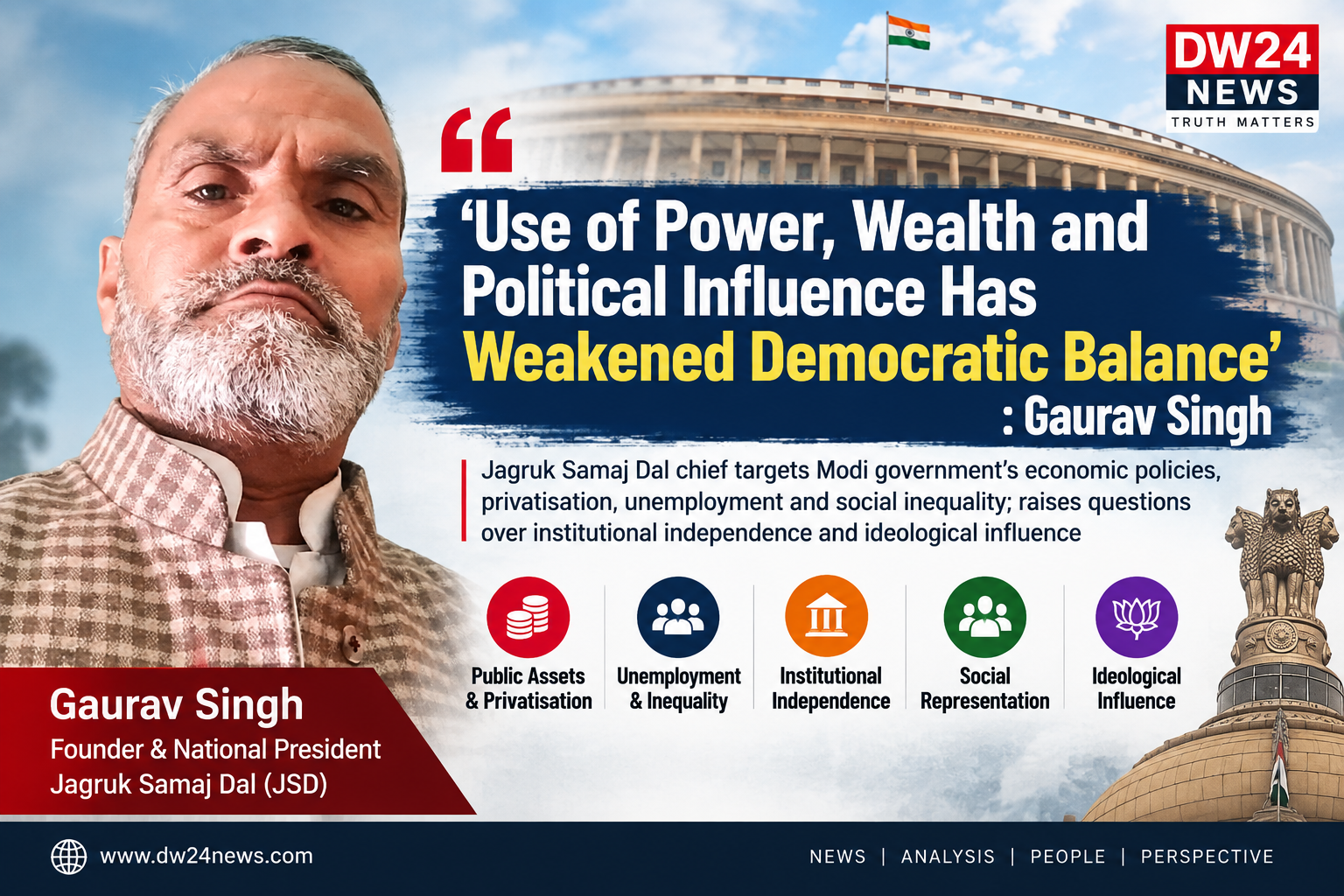
Jagruk Samaj Dal chief targets Modi government’s economic policies, privatisation, unemployment and social inequality; raises questions over institutional independence and ideological influence
New Delhi: Jagruk Samaj Dal (JSD) founder and national president Gaurav Singh has launched a broad political critique of the Narendra Modi government, questioning what he described as the growing concentration of political power, economic influence and ideological dominance in the country’s public institutions.
Singh alleged that the use of political authority, economic resources and institutional influence had affected the balance within India’s democratic system and raised concerns about the independence of institutions, social representation and citizens’ rights.
His remarks cover a wide range of issues—from public-asset monetisation and private-sector participation to unemployment, social inequality, representation of marginalised communities and the political interpretation of Hindutva.
Singh’s assertions are political claims and have not, in themselves, established institutional wrongdoing. Any conclusion regarding the independence of a particular institution or alleged preferential treatment in an economic transaction would require examination of the relevant decisions, procedures, regulatory records and documentary evidence.
Public Assets, Monetisation and the Private Sector
A central part of Singh’s criticism is directed at the government’s policy of monetising public-sector assets and increasing private-sector participation in infrastructure.
The Union government launched the National Monetisation Pipeline 2.0 (NMP 2.0) in February 2026. According to the government and NITI Aayog, the five-year programme covering FY 2026-30 carries an indicative monetisation potential of ₹16.72 lakh crore, including around ₹5.8 lakh crore of private-sector investment. The pipeline covers sectors including highways, railways, power, ports, coal, mines, civil aviation, urban infrastructure, telecommunications and tourism.
The government has presented asset monetisation as a mechanism for unlocking value from existing assets and recycling resources into infrastructure and new capital expenditure.
Singh, however, has questioned whether such large-scale participation of private capital in public assets is receiving adequate public scrutiny. He has argued that questions of ownership, access, valuation, concession terms, transparency and long-term public interest should remain central to the debate.
He also referred to the Adani and Ambani groups while raising broader political questions about the relationship between the government and large corporate houses.
Such references, however, do not by themselves establish preferential treatment. Any allegation of favouritism would have to be assessed transaction by transaction, including the tendering process, eligibility conditions, valuation, bidding competition and regulatory approvals.
What the Official Disinvestment Data Shows
The government’s own data provides a measure of the scale of its current asset-management and disinvestment programme.
The Department of Investment and Public Asset Management (DIPAM), under the Ministry of Finance, records ₹55,757.29 crore in disinvestment receipts for FY 2026-27 on its current dashboard. The figure includes proceeds from transactions involving companies such as LIC, Coal India, NHPC, NLC India, GIC, IRFC, Cochin Shipyard and Hindustan Copper.
DIPAM states that its mandate covers strategic disinvestment, minority stake sales and capital management of Central Public Sector Enterprises.
The distinction between asset monetisation, minority stake sale and strategic disinvestment is significant. Asset monetisation can involve unlocking value from existing assets through mechanisms such as concessions or other commercial arrangements, whereas disinvestment involves the government reducing its equity stake. Treating all such transactions simply as “privatisation” can therefore obscure important differences in policy and ownership structures.
Unemployment, Inequality and the Question of Economic Participation
Singh has also made unemployment and economic insecurity among young people central to his criticism of the government.
He argued that India’s development debate cannot be confined to headline economic growth and infrastructure investment without examining the quality and distribution of employment opportunities.
According to Singh, educated, skilled as well as less-skilled young people continue to face concerns over stable employment and economic security. He further argued that workers and socially disadvantaged communities need greater access to education, skills, employment and social protection.
He specifically referred to backward and extremely backward communities, Dalits, Adivasis, workers and economically disadvantaged sections, arguing that development should be accompanied by greater participation and representation of these groups.
The larger political question raised by Singh is whether economic expansion is translating into sufficiently broad-based social and economic mobility.
Singh Challenges Political Interpretation of Hindutva
Singh also criticised the political interpretation of Hindutva associated, in his view, with the BJP and organisations including the RSS, VHP and Bajrang Dal.
He argued that political discussions centred on religious identity should not overshadow questions of caste, economic inequality, social representation and access to opportunities.
Singh said religious faith could remain a matter of individual belief, while democratic governance must operate on the principles of equal citizenship, constitutional rights and individual freedoms.
He also called for greater emphasis on scientific temper and a human-centred approach to social reform, while opposing what he described as superstition and discrimination in the name of religion.
These remain political and ideological positions advanced by Singh and JSD rather than independently established findings about the organisations or institutions he criticised.
Institutions, Representation and Democratic Accountability
One of the broader arguments in Singh’s statement concerns the functioning of India’s major democratic institutions.
He questioned the independence and social diversity of the legislature, executive, judiciary and media, alleging that political and ideological influence has increasingly affected institutional functioning.
The allegation raises a larger issue of democratic accountability, but institutional independence cannot be assessed as a single proposition. It requires examination of individual appointments, judicial and administrative decisions, legislative processes, media ownership and regulatory frameworks, along with the constitutional safeguards governing each institution.
For that reason, Singh’s claims would require institution-specific evidence before broader conclusions could be drawn.
JSD Sets 2029 Organisational Target
On the organisational front, Singh said the Jagruk Samaj Dal is working across several states, including Uttar Pradesh, Uttarakhand, Bihar, Jharkhand, Madhya Pradesh, Maharashtra, Rajasthan and Delhi.
He claimed that organisational teams have been established in several districts from the booth level to the Lok Sabha constituency level, with expansion continuing in other areas.
According to Singh, the party’s stated objective is to establish booth-level organisational structures in between five and 25 districts in each of its target states by the 2029 Lok Sabha elections.
He said the party’s objective was not limited to electoral contests but also included expanding political awareness around social justice, equality, liberty, scientific thinking and constitutional values.
The Larger Political Argument
Singh’s intervention brings together several strands of the current political debate—public-asset monetisation, private investment in infrastructure, employment, inequality, social representation, ideological politics and institutional accountability.
The Modi government, meanwhile, has presented asset monetisation and private investment as instruments for unlocking the value of mature public assets, financing infrastructure and supporting economic growth. NITI Aayog’s NMP 2.0 document specifically describes the programme as a framework for monetising public-sector assets and reinvesting resources into infrastructure creation.
The political contest, therefore, is not simply over whether public assets should be monetised, but over how such assets are valued, who receives access to them, how transactions are conducted, what safeguards are applied and how the resulting economic benefits are distributed.
For JSD and Singh, these questions are inseparable from their wider argument about social justice and democratic accountability. For the government, the stated policy rationale is infrastructure creation, efficient use of existing assets and mobilisation of private capital.
The debate is consequently moving beyond the traditional government-versus-opposition framework and towards a wider question: how should economic power, public assets and political authority be balanced within a democratic system?