

New Delhi, Delhi
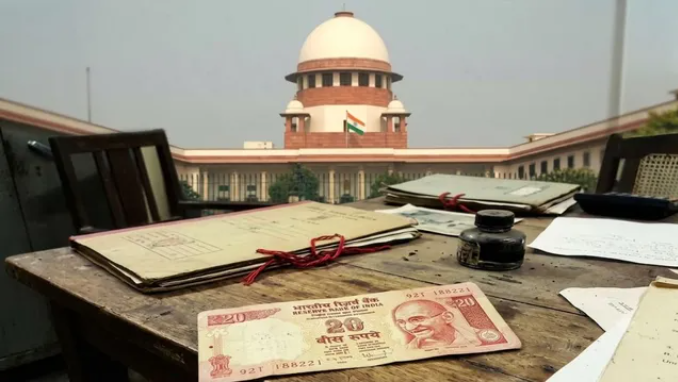
A case involving an alleged ₹20 bribe in Gujarat continued through the courts for nearly 30 years. The legal battle, which began in February 1996, has now come to an end with a Supreme Court verdict. The apex court overturned the convictions of a clerk and a peon working for the Gujarat government and acquitted both of them.
In its judgment, the Supreme Court observed that the mere recovery of alleged bribe money from an accused is not sufficient, by itself, to establish guilt. The prosecution must first prove that a bribe was demanded and that the accused accepted it.
The case originated from Bechari Gram Panchayat in Anand district. A student had approached the panchayat office to obtain an income certificate so that he could receive a concession in his educational fees. According to the prosecution, the concerned clerk allegedly demanded ₹120 for issuing the certificate. It was alleged that ₹100 was meant for the clerk and ₹20 for the peon.
The student reported the alleged bribe demand to the Anti-Corruption Bureau (ACB). Following the complaint, the agency planned a trap operation. The student was instructed to hand over the entire ₹120 if the demand was made. He subsequently went to collect his income certificate.
After receiving the certificate, the student handed ₹20 to the peon. The ACB team immediately intervened and recovered the same notes from the peon. However, the alleged ₹100 share meant for the clerk was not recovered from him. This raised several questions regarding the prosecution’s case.
The matter eventually reached the courts, where proceedings continued for years. The trial court convicted the accused, and the Gujarat High Court later upheld the lower court’s decision. The case was subsequently taken to the Supreme Court.
A bench comprising Justice Ujjal Bhuyan and Justice Atul S. Chandurkar examined the records and statements of the witnesses in detail. The court found significant inconsistencies in the complainant’s statements. In one statement, the student had said that the accused initially demanded ₹200 and later agreed to ₹120. However, this version did not emerge in his testimony before the trial court.
The bench also considered another important aspect of the ACB trap. Although the agency had instructed the student to hand over the full ₹120, he gave only ₹20 to the peon. The court questioned why the remaining ₹100 was not handed over to the clerk if the clerk was also allegedly involved in the demand and was present next to the peon.
During cross-examination, the student also admitted that the peon himself had not demanded any bribe from him. Furthermore, the ₹20 was handed over only after the student received the income certificate. The peon offered a different explanation for receiving the money, stating that the student had given it to him because Eid was the following day.
The Supreme Court also examined the issue of the statutory presumption under Section 20 of the Prevention of Corruption Act. The bench clarified that such a presumption based on the recovery of alleged bribe money can arise only after the prosecution establishes that a demand for the bribe was actually made. In this case, the alleged initial demand itself was not established beyond reasonable doubt.
The court held that the circumstances of the case were not sufficient to make the prosecution’s version completely reliable. It ruled that the peon’s conviction could not be sustained merely because ₹20 had been recovered from him.
On these grounds, the Supreme Court set aside the judgments of the trial court and the Gujarat High Court and acquitted both the clerk and the peon. With this verdict, the alleged ₹20 bribery case that began in 1996 finally came to an end after nearly three decades of litigation.