

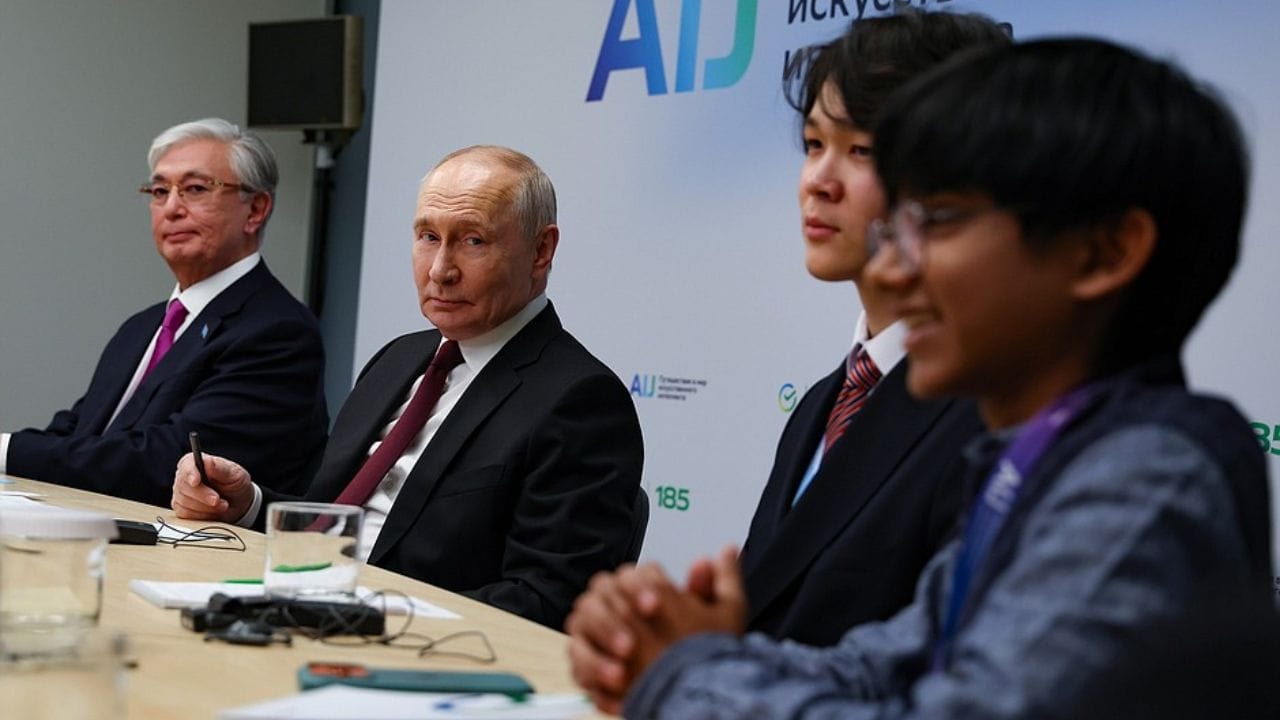
In a global AI briefing hosted by Russian President Vladimir Putin, 17-year-old Indian student Raul John Aju drew widespread attention after participating in a high-profile meeting on artificial intelligence. The session, held on November 25, gathered leaders and company owners from around the world, including delegates from Kazakhstan. Aju, who heads the AI tech firm ThinkCraft, attended the event and spoke on stage, presenting his ideas to the assembled audience.
Reports from Russia Today describe how Aju, known for his early fascination with technology, directly asked Putin for a selfie during the encounter. The Russian president complied, bending slightly and smiling for the photo, a moment that quickly circulated on social media and became a talking point across Indian and international tech circles. Aju’s father, Ajju Joseph, celebrated the moment in a social post, calling it a proud moment for a father’s perspective.
The meeting’s setting and attendees positioned Aju among influential voices in AI, signaling the impact of India’s young innovators on a global stage. Officials noted that while discussions with top executives rarely feature such direct exchanges, Putin’s willingness to engage with Aju underlined the broader openness of the forum to emerging minds presenting fresh solutions in AI technology.
Beyond the selfie, Aju reportedly contributed remarks during the session, leaving an impression on the Russian president regarding his work and his age. Putin is said to have complimented Aju on the significance of his projects, acknowledging how young Indian engineers are shaping the trajectory of accessible AI development and its real-world applications. The exchange highlighted the evolving dynamic between national leaders and aspiring tech entrepreneurs.
In a public post accompanying the photo, Raul John Aju recalled his journey, mentioning that at age nine he produced a video in a bathroom and that the subsequent years have been a thrilling ride. His father’s background in a tech company provided Aju with early exposure to software and product development, fueling his curiosity about artificial intelligence and its practical uses in education and industry.
Aju explains that his early interest culminated in the creation of a robot named Mebot during his schooling. Later, during his 12th-grade year, he established ThinkCraft, the AI company that now employs about 15 people, including his father. He noted that the enterprise pays his father a monthly salary of 2 lakh rupees, while the firm trains AI professionals and has already extended training to roughly 5 lakh people. These figures underscore the scale of his venture and its ambitious reach in AI education and innovation.
The coverage of Aju’s achievements points to a broader narrative about youth-led innovation in India and the perception of AI as a practical driver for economic progress. His story is being cited by media outlets and public accounts to illustrate how young minds, with mentorship and family support in tech, are contributing to cutting-edge fields, and how such contributions are acknowledged in high-level international forums.
As the event concluded, observers noted that Putin’s engagement with Aju, and the subsequent social media response, may influence future collaborations and perceptions of India’s role in global AI initiatives. The coverage also reaffirms the continued interest of global leaders in showcasing emerging tech talents who can translate novel ideas into scalable, real-world solutions. While the full implications remain to be seen, Aju’s appearance marks a notable moment for Indian youth in tech innovation.