

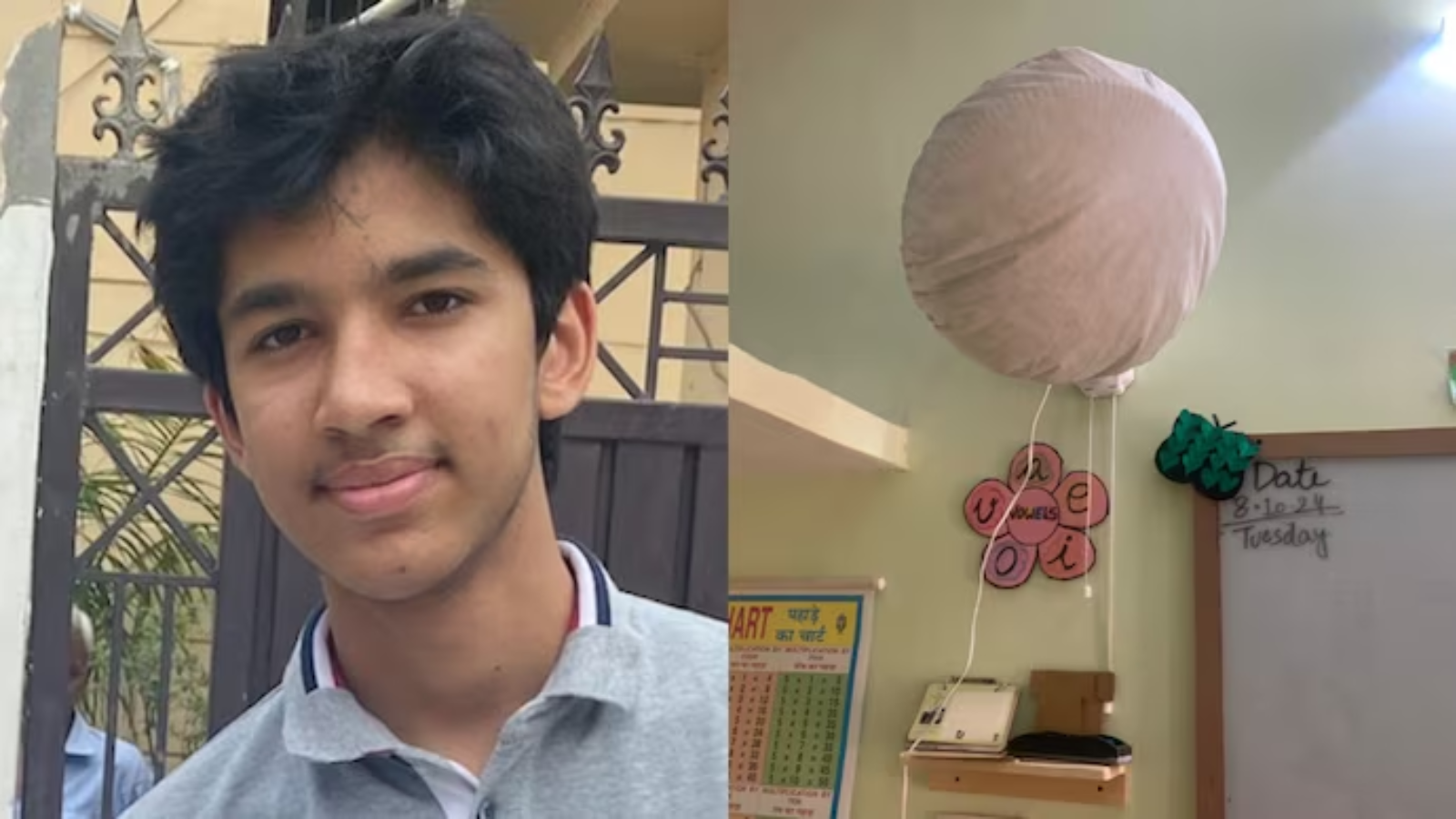
Krish Agarwal, a 16-year-old student in Delhi, turns a regular fan into an air purifier for ₹140, making clean air easier to access. Krish, along with his friend Samarth Mittal, launched Project Vayu to reduce indoor pollution in homes and classrooms. The project highlights affordability and practical use in everyday environments, aiming to help those who can’t buy costly purifiers.
How Project Vayu Works
Under Project Vayu, a special electrostatically charged fiber filter is designed to fit onto any ordinary fan. The filter captures polluted air and extremely fine dust particles, using static electricity to pull tiny contaminants from the airstream and hold them, reducing what recirculates into the room. Once the fan starts, the filter swells like a balloon, expanding its reach across the space.
In controlled tests inside a closed room, the filter achieved a dramatic drop in PM2.5 levels. When the purifier was off, PM2.5 hovered at about 158 micrograms per cubic meter, but after running for an hour with the device in place, the level fell to 11 micrograms per cubic meter, representing roughly a 90% reduction.
Impact and Reach
The 140-rupee filter shows that affordability does not limit effectiveness. In school-style testing, the device showed a significant drop in PM2.5 levels inside a closed room, demonstrating that a low-cost solution can contribute meaningfully to indoor air quality for students and families who may not access high-end purifiers.
The initiative is being rolled out in schools at no cost, with filters distributed freely and replaced periodically to maintain effectiveness. Officials say the program can be scaled to other institutions, offering a practical means to improve air quality in classrooms where students spend long hours indoors. The approach emphasizes maintenance and ongoing support.
Krish Agarwal’s work earned him recognition as part of the Diana Award 2026, highlighting the initiative’s impact beyond a single classroom. The effort has already benefited more than 10,000 schoolchildren, underscoring the potential reach of an affordable solution in addressing indoor air pollution. The award recognizes not only innovation but also the social impact achieved through education and community engagement.
Initially, Project Vayu produced 602 filters and covered 295 classrooms, bringing relief to about 8,000 students. The team is planning to deploy the same concept in 45 more Delhi schools, expanding the program’s reach and potentially multiplying its benefits for learning environments affected by air pollution across the city today.
By turning a common household device into a low-cost air-cleaning tool, Project Vayu demonstrates how simple innovations can address urban air pollution. If scaled across more schools, homes and institutions, the approach could contribute to cleaner indoor air and better health outcomes for students and families in Delhi and beyond, highlighting a model for community-driven science.