

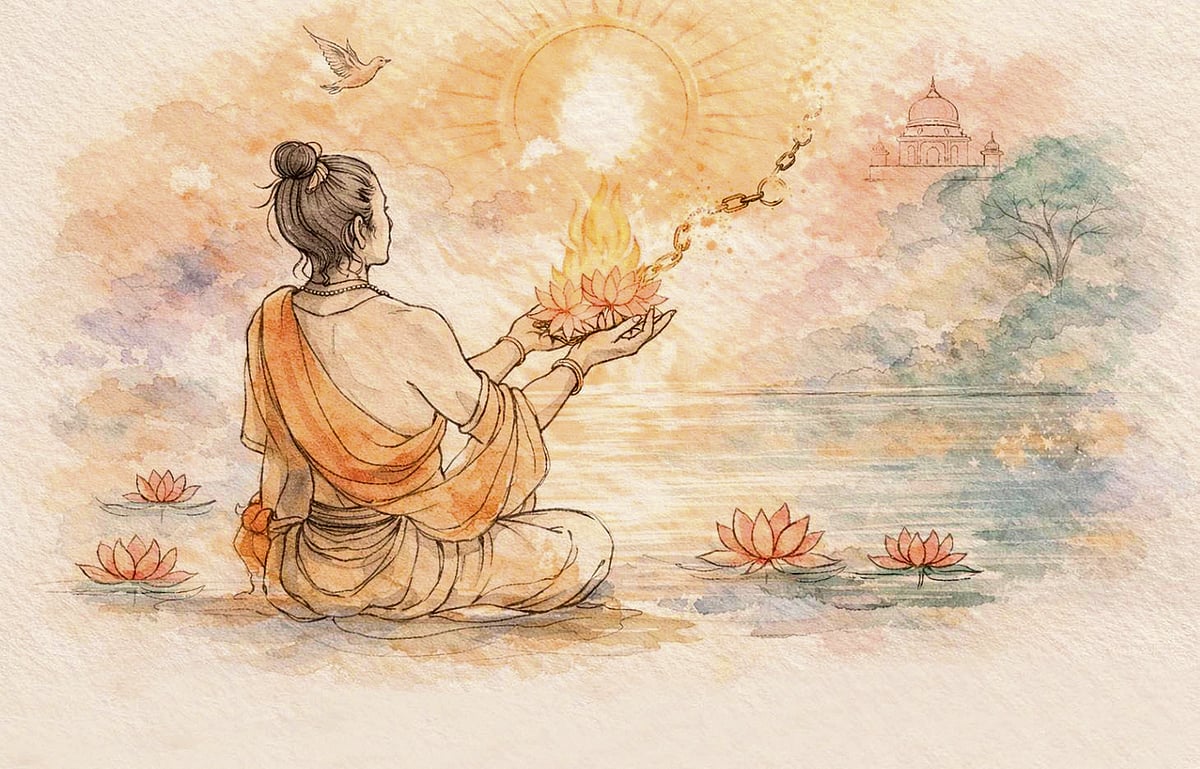
The article examines how entitlement and gratitude shape modern life, explaining that Vedic wisdom dismisses entitlement and elevates gratitude as part of cosmic order. It notes that the roots of this principle appear in ancient texts like the Vedas, particularly the Isavasya Upanishad.
Entitlement and the ego in Vedic thought
To understand the Vedic view of entitlement, one must look at ahankar, or the ego-sense. Vedic philosophy says entitlement stems from Vikrit Ahankara, the perverted ego-self, which sees oneself as the sole doer and rightful claimant to rewards. This is described as an illusory state. The Isavasya Upanishad opens with a declaration: ‘Isavasyam idam sarvam’—everything material in the universe is controlled and owned by Ishwar. Therefore, human beings own nothing. We are merely trustees of the resources provided to us. When ownership is exposed as an illusion, the mental foundation of entitlement collapses.
From debt to duty: the rina framework
In place of entitlement, the Vedic tradition presents rina, or cosmic debt. According to the ancient text Manusmriti, every human being is born not with a stated set of rights but with a ledger of inherent debts. These debts have to be discharged through the fulfilment of duties. We owe a debt to the divine forces of nature (Deva Rina) that provide the five primordial elements—air, water, earth, fire and ether. We owe a debt to the seers and savants (Rishi Rina) who preserved knowledge for our guidance. We owe a debt to our ancestors (Pitri Rina) who gave us life, physical nurture, lineage and values. This framework shifts human consciousness from asking, ‘What is the world giving me?’ to asking, ‘How can I repay what I have already received?’ By framing existence as a web of mutual debts, the Vedic tradition makes gratitude the natural baseline of human existence. This gratitude is demonstrated through the practice of yagya, or sacrifice. Yagya is the Vedic ritual of making offerings into a sacred fire, but at its core, it represents the law of reciprocity. Our scriptures explain that the universe operates on a cycle of mutual nourishment between humans and cosmic forces. To take from nature and society without giving back is explicitly termed theft. Therefore, practising gratitude is a moral and cosmic necessity.
Gratitude as prasad and the path of Nishkama Karma
This leads naturally to the concept of prasad—treating every valuable worldly item received as divine grace or a sanctified gift. When a person views life through the lens of entitlement, a meal, a pay cheque or an act of material endowment is merely seen as a right fulfilled, leaving the person hungry for more. However, when viewed through the Vedic lens, every breath, every morsel of food and every moment of joy is recognised as prasad. This shifts the mind into a state of gratitude, where we acknowledge that our individual efforts account for only a small part of what brings success; the rest comes from a complex interplay of cosmic forces and the collective support of other human beings.
From entitlement to gratitude through Nishkama Karma
Ultimately, the Vedic path guides an individual from the agony of entitlement to the composure of gratitude through the practice of Nishkama Karma—performing one’s duty without demanding or obsessing over the fruits of one’s actions. Entitlement is always obsessed with outcomes, leading to anxiety and anger when expectations are unmet. Gratitude, rooted in Vedic wisdom, focuses on the privilege of being able to act in sync with, serve and contribute to the cosmic order, or rita. By anchoring our identity not in what we can extract from life but in how gracefully we can participate in it, Vedic philosophy provides an enduring blueprint for peaceful, contented living and sublime fulfilment throughout life.
Follow The New Indian Express channel on WhatsApp Download the TNIE app to stay with us and follow the latest